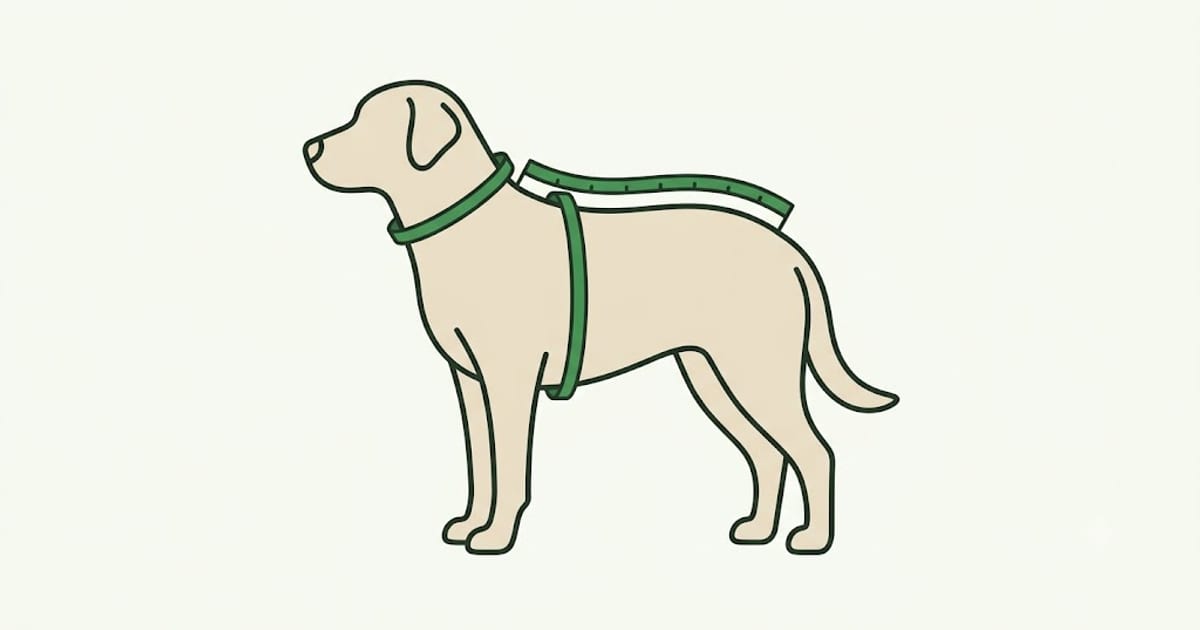
Harnesses are sized on chest girth: the distance around the widest part of your dog's ribcage, just behind the front legs. Measure with the dog standing square, pull the tape snug against the body but not tight, and read the number where the tape meets on top of the back. Most harnesses also need a neck measurement, taken low at the base of the neck where a collar sits.
Those two numbers, plus the right technique, decide almost every harness fit. The rest of this page explains exactly where the tape goes, the common mistakes, and how to read a size chart once you have the numbers.
What you need
- A soft tailor's tape measure. If you do not have one, use a piece of string or a phone charging cable, mark where it meets, and measure it against a ruler.
- Somewhere level for the dog to stand.
- A second person, a treat, or both. Dogs rarely hold still for a stranger with a tape.
Step 1: Measure chest girth
Stand the dog square, with all four feet under the body and the head level. A sitting or lying dog gives a different measurement because the ribcage changes shape.
Find the dog's elbows, the point where the front legs meet the body. Place the tape around the chest a little behind the elbows, at the deepest and widest part of the ribcage. On most dogs this is about two finger widths behind the elbow.
Bring the ends together on top of the back. Pull the tape snug so it lies flat against the body, then check that you can slide two fingers flat under it. Read the measurement at that tension.
Measure two or three times and use the largest reading that is still snug. Dogs breathe, shift and brace, and a single measurement can be off by an inch.
Where people go wrong
The two most common placement errors both give a reading that is too small.
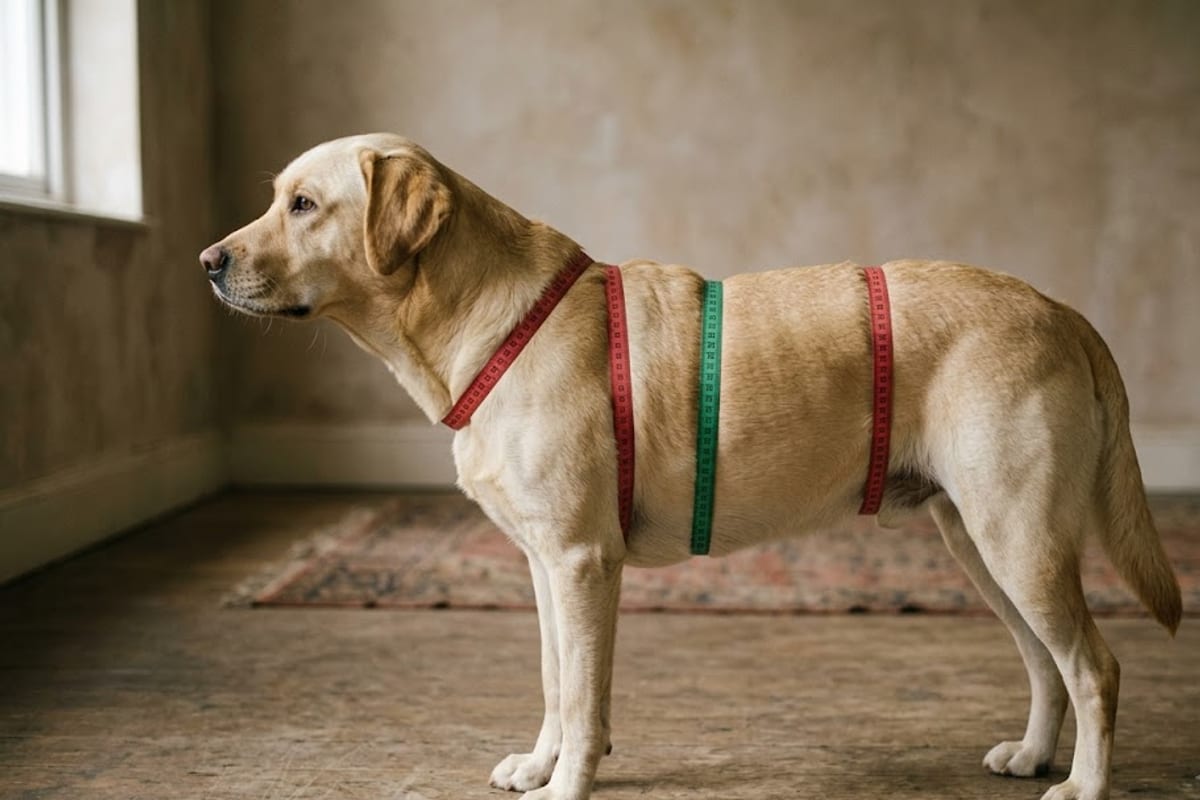
Too far forward. A tape tucked into the armpits, tight against the back of the front legs, measures the narrow part in front of the ribcage. The harness bought from this number will be too small around the chest.
Too far back. A tape around the waist, in front of the hind legs, measures the narrowest part of the body. This is a much bigger error on deep-chested breeds like Greyhounds, Dobermans and Boxers, where the waist can be many inches smaller than the chest.
Step 2: Measure the neck
Most harnesses have a strap or opening around the neck, and on overhead designs it has to pass over the head. Measure the neck low down, at the base, where a collar would naturally sit and where the neck meets the shoulders. A tape placed high up under the jaw gives a smaller number.
If you are buying an overhead harness, also measure around the widest part of the head, usually across the ears and cheeks. If the head is wider than the harness's largest neck setting, the harness will not go on. This is a common problem with broad-headed breeds such as Bulldogs and Staffordshire Bull Terriers.
Step 3: Measure length, if the harness asks for it
Some vests, step-in harnesses and coats also use back length, measured along the spine from the base of the neck to the base of the tail. Strap harnesses usually do not need it.
Thick and double coats
On a double-coated dog, measure against the body, not over the fluff.
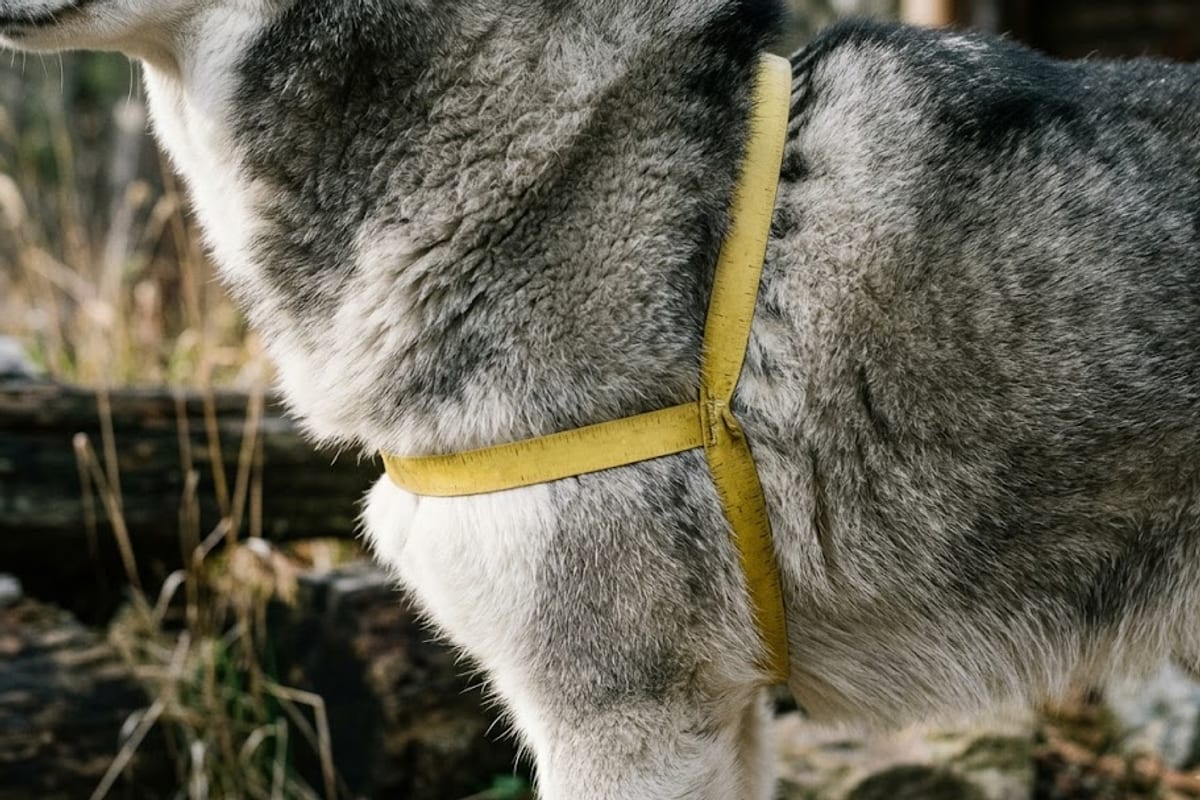
Push the tape down through the coat so it rests close to the skin, then take the reading. If the dog will wear the harness in full winter coat, you can add a small allowance on purpose, often around half an inch to an inch on a heavily coated dog, rather than picking up extra length by accident. For dogs whose coat changes a lot between seasons, choose a harness with a wide adjustment range.
Reading a size chart
Once you have the girth, compare it with the manufacturer's chart for the specific harness you are buying. Charts differ between brands and sometimes between models from the same brand. As an example, Ruffwear's harness size chart uses these girth ranges:
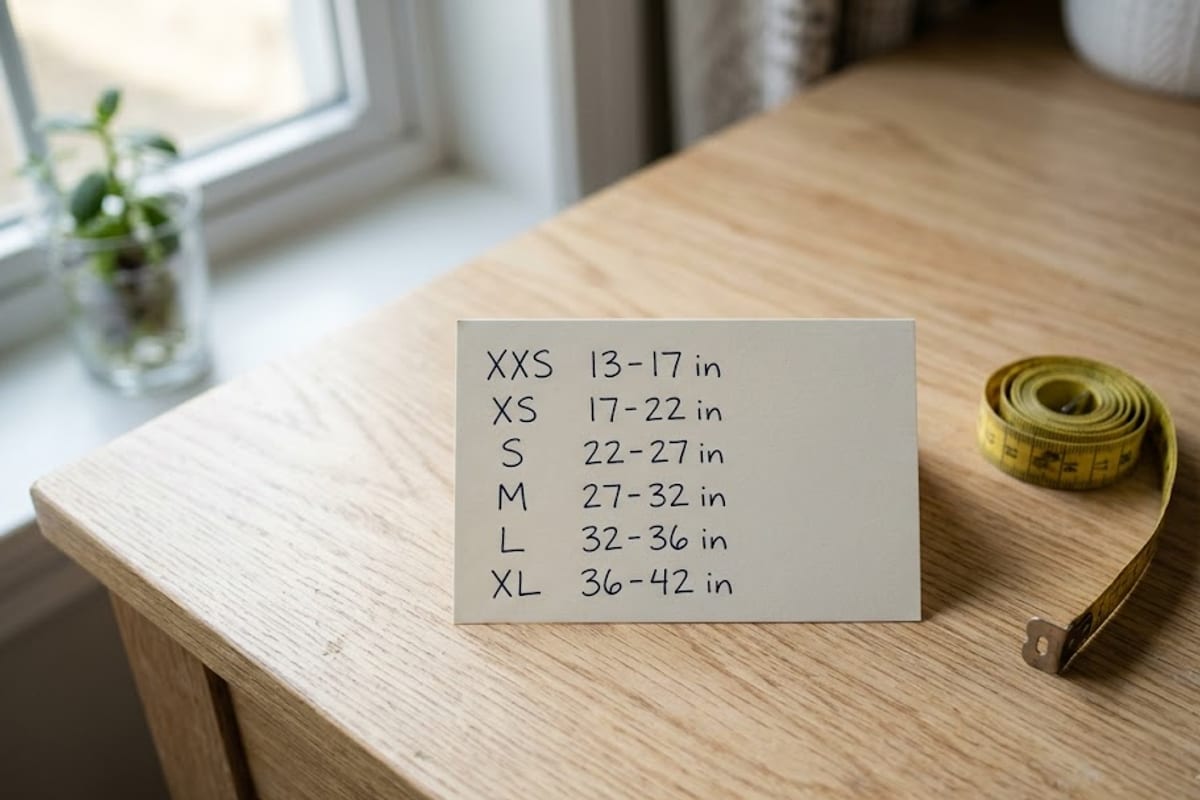
| Size | Chest girth (in) | Chest girth (cm) |
|---|---|---|
| XXS | 13–17 | 33–43 |
| XS | 17–22 | 43–56 |
| S | 22–27 | 56–69 |
| M | 27–32 | 69–81 |
| L | 32–36 | 81–91 |
| XL | 36–42 | 91–107 |
Each size spans only about 4 to 5 inches. A one-inch measuring error can move a dog into the next size, which is why careful placement matters.
When your dog is between sizes
If the girth falls on the boundary between two sizes, most manufacturers, including Ruffwear, suggest choosing the larger size, as long as the harness can be adjusted down to fit snugly. A slightly large harness tightened down fits. A slightly small harness cannot be let out.
For puppies, Ruffwear gives the example of a 3-month-old puppy with a 17-inch girth, right on the line between XXS and XS, and recommends the XS for room to grow. Do not size up further than that for growth. A harness that is loose now is one a puppy can back out of.
For breed-level starting points before you measure, see the dog harness size chart by breed.
Checking the fit on the dog
The measurement gets you the right size. The final check is on the dog, once the harness is adjusted.
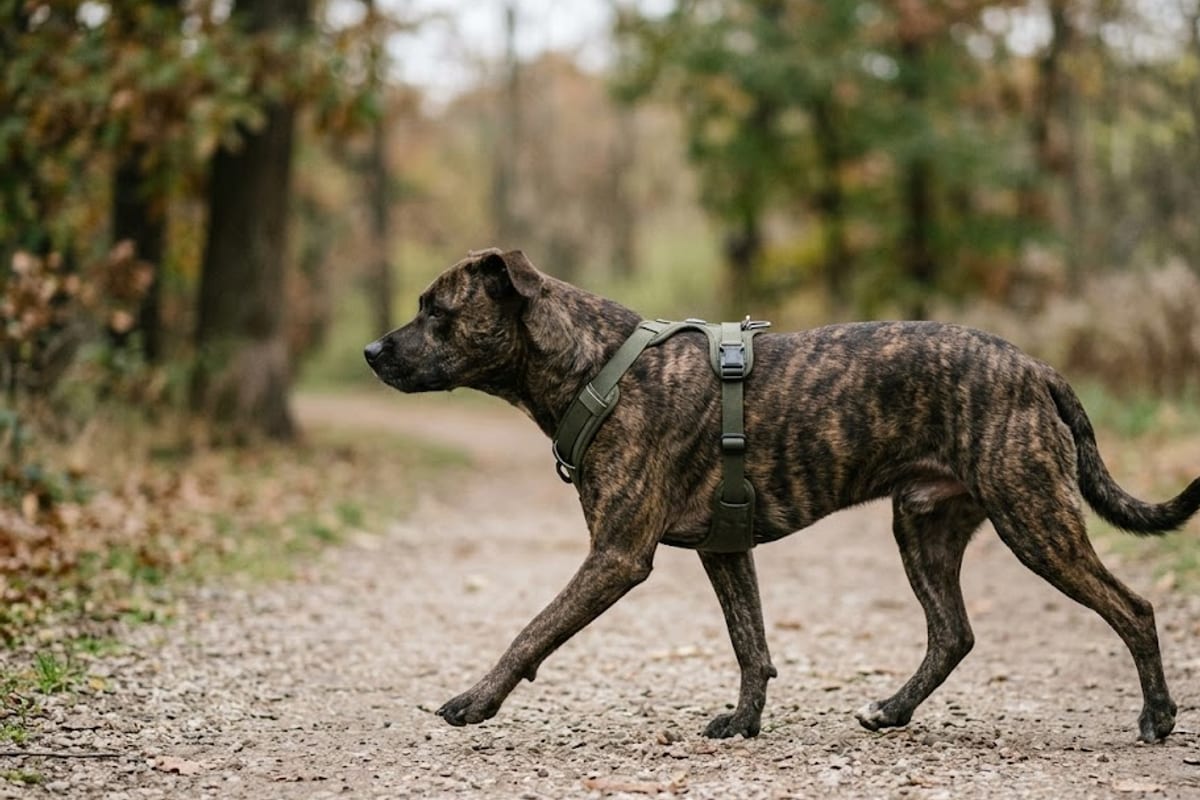
- Two fingers flat should slide under every strap.
- The chest strap sits behind the front legs, clear of the armpit. A strap rubbing in the armpit causes chafing and is one of the most common reasons a dog starts refusing a harness. More on this in harness chafing.
- The shoulders move freely. Watch the dog walk. The front legs should reach forward without the harness pulling across the point of the shoulder.
- The dog cannot back out. With the harness on, gently pull the leash forward while the dog backs up. If the harness slides over the head, tighten the neck and chest straps.
- Check again after a walk. Straps settle and loosen. Where they sit after ten minutes of walking is where they will sit on every walk.
Puppies and growing dogs
Puppies change shape quickly, and the chest often widens on a different schedule from height. Remeasure every few weeks during the first year, and check the fit of the harness each time you put it on. Once a puppy reaches the top of the adjustment range, move up a size. More on timing is in how often to remeasure a puppy, and harness choices for young dogs are covered in puppy harness size by age.
Special cases
Deep-chested dogs. Greyhounds, Whippets, Dobermans and Boxers have a large chest and a small waist, and many harnesses slide backward on them. Look for harnesses with a strap behind the ribcage or a design made for sighthounds. See harnesses for deep-chested dogs.
Barrel-chested dogs. French Bulldogs, Pugs and Bulldogs have a wide chest, a thick neck and short legs. Neck and head size often matter more than girth for them. See harness size for a French Bulldog.
Dogs that will not stand still. Measure in two or three short sessions with treats rather than one long one, or measure while the dog is eating. Tips are in measuring a dog that won't stand still.
Frequently asked questions
Where exactly is a dog's girth? Around the widest part of the ribcage, a little behind the front legs.
Should I measure girth with the dog sitting or standing? Standing. The ribcage changes shape when a dog sits.
How tight should the tape be? Snug and flat against the body, with room to slide two fingers flat underneath.
My dog is exactly between two sizes. Which do I buy? Usually the larger, provided it adjusts down to fit snugly.
Is chest girth the same as neck size? No. Neck size is measured at the base of the neck and is used for collars and for the neck opening of a harness. Collars are covered in how to measure a dog for a collar.