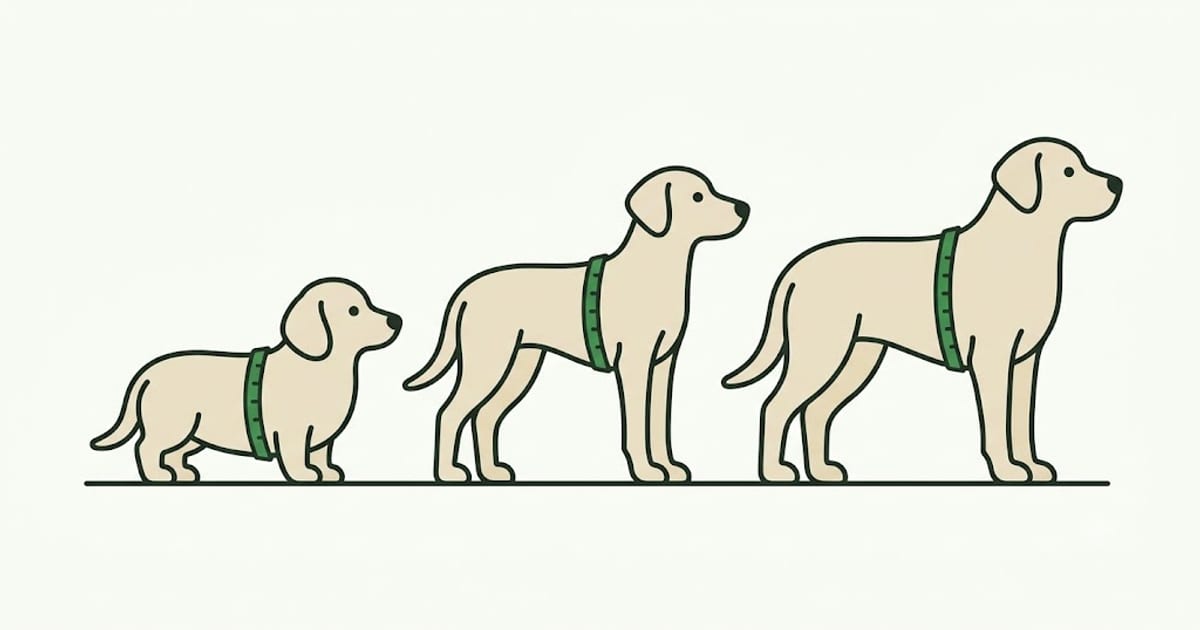
Puppy harness charts indexed on age exist because age is the number owners always know. It is also the weakest predictor of chest girth available, and it is wrong in different directions for different dogs.
Why breed and weight charts fail on adults is on the harness sizing page.
Why age fails
Breed size dominates everything. A four-month-old Great Dane and a four-month-old Chihuahua share nothing but a birthday. Any age-indexed chart has to assume a breed size, and it usually does not say which.
Growth rates differ by size class. Small breeds reach adult size at around 9–12 months. Large and giant breeds keep growing to 18–24 months, and their chest continues to broaden after their height has stopped. So "six months old" is 70 % grown for one dog and 40 % for another.
Growth is not proportional. This is the part that catches people. Puppies grow legs and height first, and the chest deepens and broadens later. A leggy adolescent at eight months can have a shallower chest than its final adult depth by a wide margin, then fill out substantially between eight and fourteen months without getting taller.
The consequence: a harness sized to a predicted adult girth does not merely fit loosely for a while. It fits wrongly shaped for the whole growth period, because the dog's proportions during growth are different from its adult proportions.
Measure, on a schedule
The only thing that works is measuring, and doing it often enough.
| Age | Remeasure |
|---|---|
| 8–16 weeks | every 2–3 weeks |
| 4–8 months | every 4–6 weeks |
| 8–12 months | every 6–8 weeks |
| Large breeds, 12–24 months | every 2–3 months |
Girth, neck and topline, standing square, snug against the body. The method is on the measuring page.
Between formal measurements, the two-finger check does the same job in five seconds: if you can no longer slide two fingers flat under the girth strap, it is time to adjust or replace.
Do not buy big
The temptation is to buy something the puppy will grow into. It produces two problems and solves neither.
It does not fit now. An oversized harness rotates, sits in the armpit, and — the serious one — can be backed out of. A puppy that discovers it can reverse out of a harness will do it again, usually at the least convenient moment. This is a genuine safety issue during exactly the period when the dog has the least recall.
It still will not fit later. By the time the puppy's girth catches up, the harness has been rubbing and rotating for months, and the puppy's proportions have changed shape rather than just scale.
Buy for the dog you have. Expect to buy two or three harnesses through the first year for a medium breed, more for a large one. That is the normal cost of a growing dog, not a failure of planning.
What to look for instead
Since replacement is inevitable, optimise for stretching each purchase as far as it goes:
- Wide adjustment range. Four adjustment points rather than two. The range printed on the packaging matters more than the size label.
- Adjustable neck as well as girth. Many harnesses adjust girth only, which means the neck is fixed and the useful life is short.
- Simple, light construction. A puppy does not need a heavily padded tactical harness, and lighter designs are easier for a small dog to move naturally in.
- Step-in or fully unbuckling. Easier on a wriggling puppy, and no head involvement while the puppy is still learning to accept handling.
Fit checks matter more on a puppy
Everything on an adult fit check applies, and two things matter more:
Nothing in the armpit. Puppy skin is softer and a strap in the crease produces a sore faster than it would on an adult. Check after every walk in the first weeks.
Full shoulder movement. A growing dog's gait is developing, and a harness that restricts the shoulder is worth catching early.
Backing out. Test in an enclosed space before you rely on it anywhere near traffic. Take up the lead and let the puppy reverse against it, and watch what happens at the neck.
What this page does not cover
- Measuring technique is on the measuring page.
- Adult breed ranges are on the harness sizing page.
- Training and lead manners, which is the other half of walking a puppy.
- Anything veterinary. Growth rates, exercise limits for growing joints and body condition all belong with a vet.
Measure every few weeks, buy for now, and never buy big.