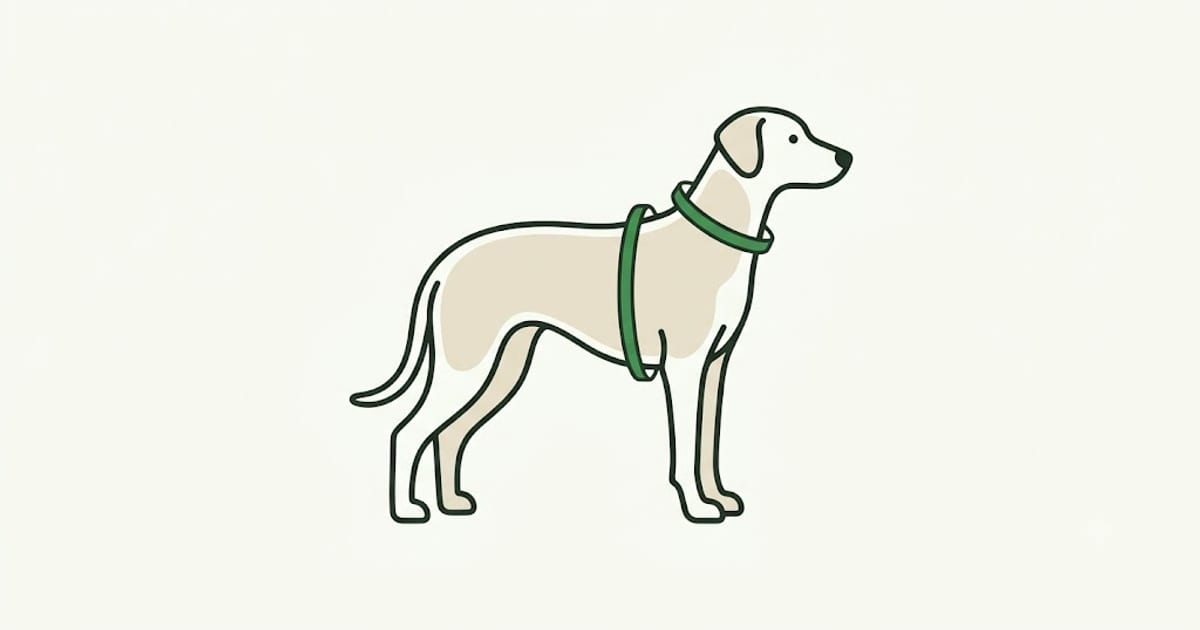
Sizing charts work from two numbers: chest girth and neck. Deep-chested dogs break that system, because girth alone does not tell you the shape the girth is made of.
Same number, different dog
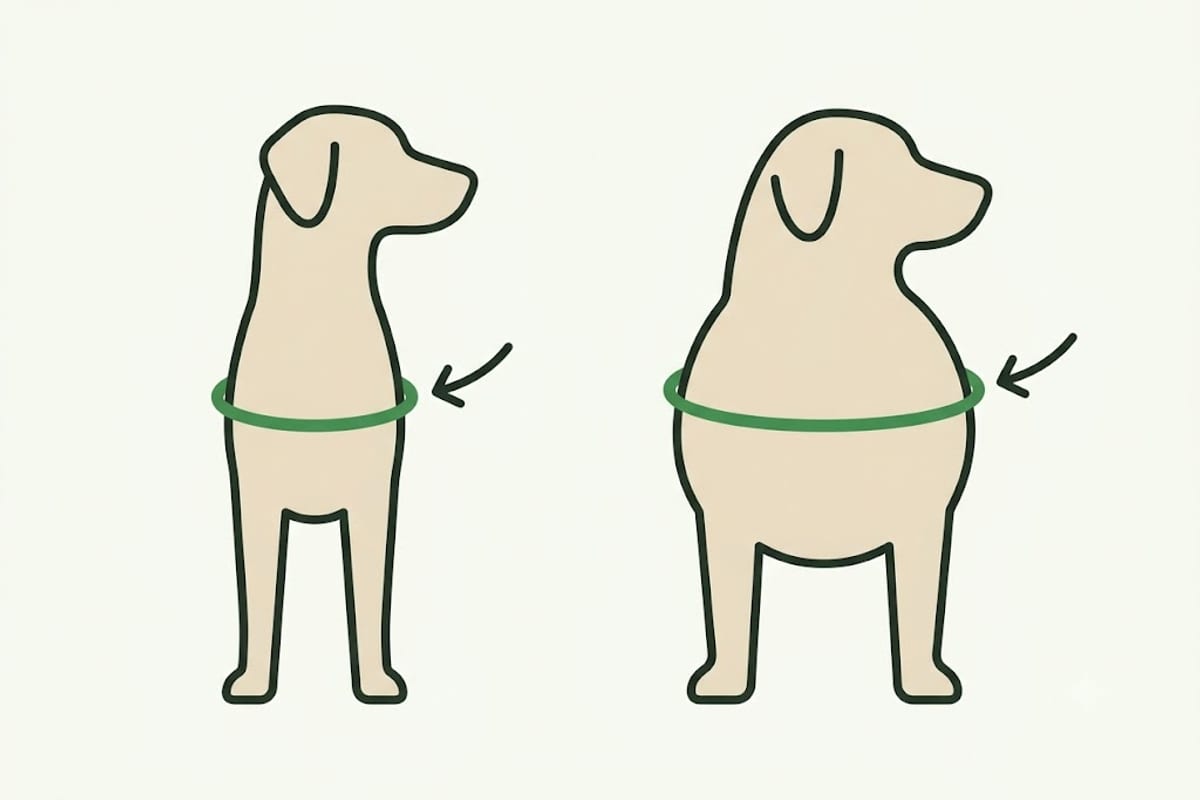
Take two dogs both measuring 28 inches around the chest. One is a greyhound-type — tall, narrow, deep from spine to sternum. The other is a bulldog-type — short, wide, barrel-shaped.
A harness built as a fixed loop of 28 inches fits both in circumference and neither in shape. On the deep dog it sits too high and rides forward into the armpits. On the round dog it slides back and rotates.
This is why deep-chested owners so often report that a harness "fits by the chart and does not fit on the dog."
The three measurements that matter
Most charts ask for one. Take three.
Girth — around the deepest part of the chest, just behind the front legs.
Neck — at the base, where a collar sits.
Body length — from the base of the neck along the spine to roughly where the girth strap will sit.
The third one is the one nobody takes, and on a deep-chested or long-backed dog it is the number that decides whether the rear strap clears the elbow.
What deep-chested dogs need
A Y-shaped front, not a horizontal strap.
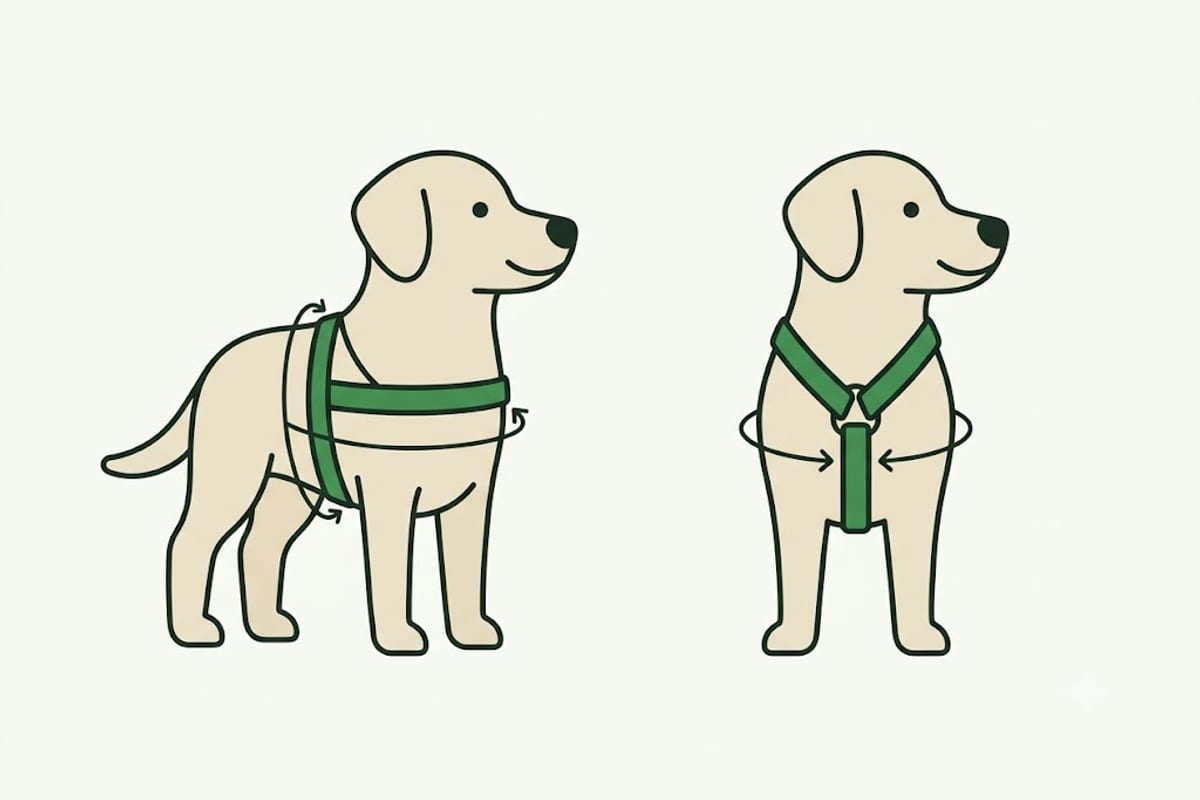
A harness with a single strap running horizontally across the front of the chest sits directly over the shoulder joints on a deep-chested dog and restricts the reach of the front legs.
A Y-front runs down the centre of the breastbone and splits, leaving the shoulders clear. On any dog it is a better shape; on a deep-chested one it is close to essential.
A long enough body. The distance from the front strap to the girth strap must be long enough that the girth strap sits well behind the elbow. Harnesses sold as "adjustable" often adjust only in circumference, not in length — check for an adjustable strap running along the belly or chest.
Adjustment at four points, not two. Neck, girth, and ideally the length as well.
Prioritising when you are between sizes
Deep-chested dogs land between sizes constantly. The rule:
Fit the chest, then adjust the neck.
Chest girth is the load-bearing dimension and the harder one to change. Neck straps are usually adjustable over a wide range and easy to bring in. So take the size whose girth range puts your dog in the middle, and expect to run the neck strap near its small end.
If a harness only adjusts at the neck, it is not the right harness for this dog.
The escape problem
Deep-chested dogs, especially sighthound types, are the classic harness escape artists. The mechanism is always the same: the dog reverses, the harness slides forward, and because the chest tapers toward the shoulders, the loop that was snug at the ribs is loose at the front.
Two things reduce it:
A third strap. Escape-proof or "double-back" harnesses add a strap further back around the belly. The dog cannot reverse out because the rear loop cannot pass the ribcage.
Correct rear-strap position. A rear strap sitting in the narrow part of the waist rather than on the ribcage gives the dog somewhere to slide to. It should sit on the ribs.
Test it deliberately: with the lead attached, get the dog to back up against gentle pressure and see what moves.
Checking the fit
With the harness on and the dog standing square:
- Two flat fingers under every strap
- The front strap clear of the shoulder joints — have someone walk the dog toward you and watch whether the front legs reach freely
- The girth strap well behind the elbow, with visible clearance through the stride
- No rotation — the front piece should stay centred on the breastbone through a walk
If the harness rotates, the girth strap is too far back, too loose, or the harness is too wide for the dog's shape.
After any change
Coat blowouts, weight changes and muscle gain from exercise all move these numbers. A working dog in condition can measure differently through the year, and a harness set in winter may need resetting in spring.
Re-measure rather than re-guess. It takes a minute and it is the only way to know which of the three numbers changed.