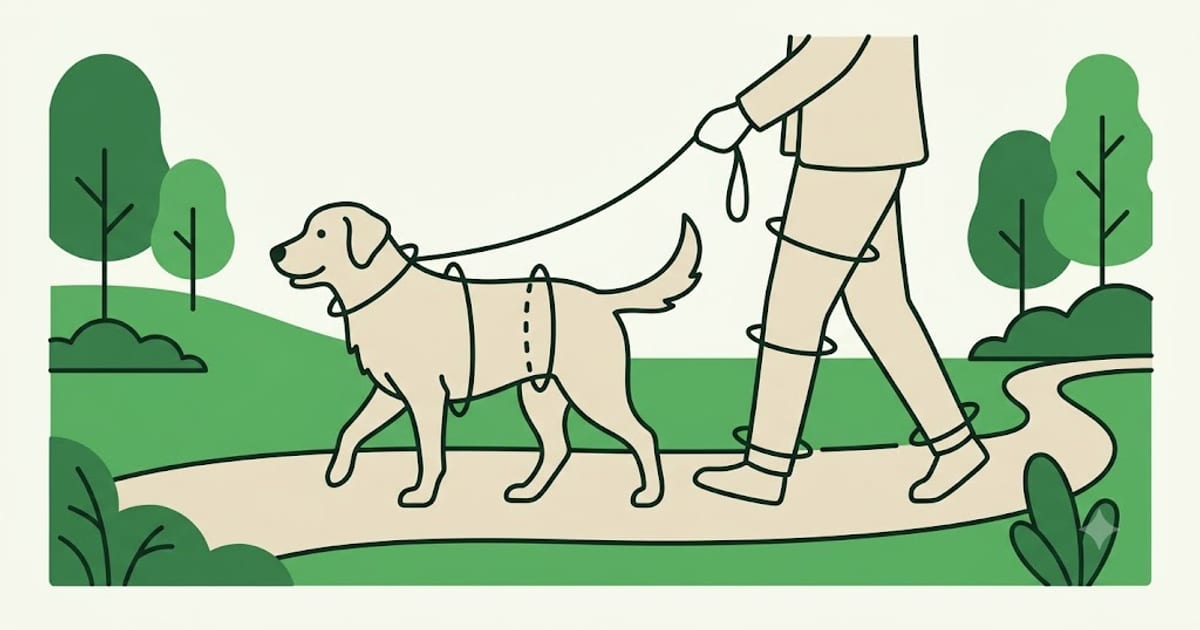
A pulling dog on a flat collar concentrates its entire pulling force on a narrow band around the throat — over the trachea, the larynx, the thyroid and the major vessels of the neck.
For most healthy adult dogs, occasional brief pressure is tolerated. For sustained pulling, and for several groups of dogs, it is not.
Dogs that must not take neck pressure
Flat-faced breeds — Pugs, French Bulldogs, Shih Tzus, Boston Terriers. Their airway is already compromised; adding pressure narrows a passage that was marginal to begin with.
Breeds prone to tracheal collapse — Chihuahuas, Yorkshire Terriers, Pomeranians. The trachea is held open by cartilage rings that in these breeds are weaker, and lead pressure is a recognised aggravating factor. Once collapse begins it does not reverse.
Sighthounds — a separate problem: their necks are wider than their heads, so a comfortable collar slips off. That needs a martingale or a harness rather than a tighter collar.
Any dog with existing neck, spine or eye conditions. Lead pressure raises intraocular pressure, which matters for dogs with glaucoma.
For all of these, a harness is not a preference. Keep the collar for identification.
What a harness does and does not do
Does: spread the force across the chest and shoulders, away from the throat. The dog can pull as hard as it likes without compressing its airway.
Does not: reduce the pulling. A harness is not a training device, and a back-clip harness can make pulling slightly worse through the opposition reflex — the sled-dog mechanism explained in front-clip against back-clip.
This is the source of the common complaint that "the harness made it worse". The harness did not teach anything, because it was never going to.
What actually reduces pulling
Stop rewarding it. A dog pulls because pulling gets it where it wants to go. If forward motion stops the moment the lead tightens and resumes when it slackens, the behaviour loses its function. This takes consistency and a few frustrating walks.
A front-clip attachment while you do that. It makes pulling less effective in the meantime, so walks are manageable during training rather than after it.
Enough exercise and sniffing time. A great deal of pulling is a dog with unmet needs trying to reach them faster.
A fixed-length lead. Extending leads teach that pulling extends the range, which is the opposite lesson.
Fit decides whether any of it works
A harness that rubs, restricts the shoulder, or lets the dog back out solves nothing regardless of type. The adjustment sequence and the shoulder test are in fitting a harness, and sizing by breed in harness sizing.
Head halters, and why they are not a shortcut
A head halter attaches at the muzzle. The head turns, and the body follows — far more leverage than any harness, and it works on the strongest dog.
That leverage is also the problem. A sharp pull, or a dog hitting the end of a long line, can wrench the neck. Head halters belong on a short lead only, never on an extending lead or a long line, and they need a proper introduction because most dogs object at first.
They manage a dog you cannot otherwise hold. They still do not teach loose-lead walking, and a dog moved back to a flat collar or harness afterwards usually pulls exactly as before.
What about slip leads and prong collars
Both work by making pulling uncomfortable, and both concentrate force on the neck — the thing this whole page is about avoiding.
Slip leads have no stopping point at all, so they tighten as long as the dog pulls. They are useful for short handling — a vet corridor, a rescue kennel — and unsuitable as everyday walking equipment for a dog that pulls.
Prong collars are restricted or banned in a number of countries. Where they are legal, they are a tool that requires instruction to use without harm, and the underlying problem is unchanged: the dog has not learned that a loose lead is what moves it forward.
If the dog is strong enough that you genuinely cannot hold it, the honest answer is a front-clip harness plus a double-ended lead while you train, and help from someone who can watch you walk the dog.
FAQ
Is a harness better than a collar for a dog that pulls?
For the dog's neck, clearly. A harness moves the force to the chest. It does not reduce pulling on its own.
Do harnesses encourage pulling?
Back-clip harnesses can, through the opposition reflex — backward pressure produces forward pressure. Front-clip designs do not.
Which dogs should never wear a collar on lead?
Flat-faced breeds, breeds prone to tracheal collapse such as Chihuahuas and Yorkshire Terriers, sighthounds, and any dog with neck, spine or eye conditions.
Will a harness stop my dog pulling?
No. It manages the consequence. Stopping the pulling requires that pulling no longer produces forward movement.
Can I use a collar for ID and a harness for walking?
Yes, and for the breeds above that is exactly the right arrangement.