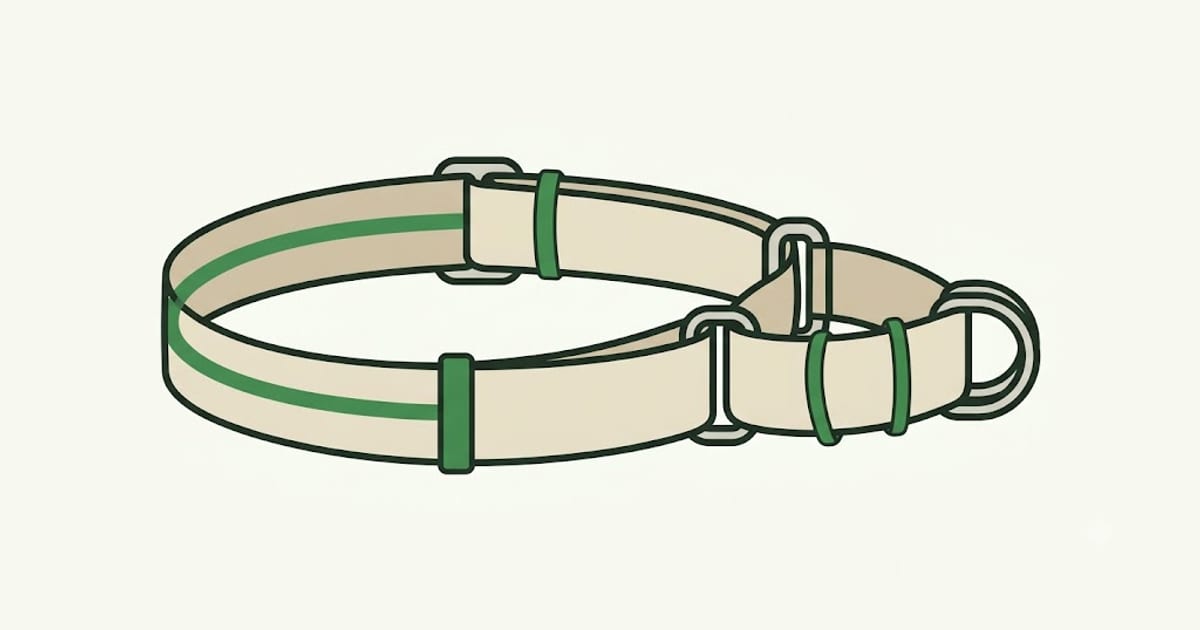
A flat collar is a single adjustable band. Simple, and correct for most dogs.
A martingale has two loops. The main loop sits around the neck; a smaller control loop carries the lead. Pull on the lead and the small loop draws the main loop closed — by a limited, preset amount, not indefinitely.
That limit is the entire design, and it is what separates a martingale from a choke chain.
Which dogs need one
Sighthounds, first and unavoidably. Greyhounds, Whippets, Salukis, Borzoi and their relatives have skulls narrower than their necks. A flat collar loose enough to be comfortable will pass over the head under backward pressure — and backward pressure is exactly what a startled dog applies.
Escape artists of any breed. Some dogs learn to reverse out of a flat collar deliberately. Once learned, it is not unlearned.
Nervous or newly adopted dogs. The moment of panic is the moment a flat collar fails, and it is likeliest in the first weeks with an unfamiliar handler in an unfamiliar place.
It is not a choke collar
Worth being precise, because the two get conflated and the difference is safety-relevant.
A choke chain has no stopping point. It tightens as long as tension continues, without limit.
A martingale is adjusted so that at full tension the main loop closes to roughly the dog's neck circumference — snug enough not to slip over the head, and no tighter. It cannot constrict further because the two rings meet and the geometry stops.
Adjusting that limit correctly is the whole job. Set too loose, it still slips off. Set too tight, it behaves more like a choke than it should.
Fitting one
- Put the collar over the head with the control loop fully open.
- Adjust the main loop until, at full tension, the two rings on the control loop just touch without overlapping.
- Check the loose fit: with no tension, it should hang comfortably, and you should be able to slide two fingers under.
- Confirm it will not pass over the head under backward pull.
Point 2 is the one people skip. Without it, the collar is just a flat collar with extra hardware.
Living with one
Do not leave it on unsupervised. The hanging loop is a snag hazard on crates, furniture and fences. Martingales are for walks; use a flat collar with ID tags for the rest of the time.
Attach the lead to the control loop, not to the main loop. Clipping to the wrong ring disables the mechanism entirely.
Re-check the adjustment after grooming and seasonally on double-coated breeds, since the closed circumference is set against a coat that changes.
Where a harness is better still
A martingale solves escape. It does not solve pressure on the throat, so it is not the answer for flat-faced breeds or dogs prone to tracheal collapse — those need the load off the neck entirely. Which breeds those are is in collar sizing by breed.
Many sighthound owners use both: martingale for control, harness for pulling.
FAQ
What is a martingale collar for?
Dogs whose head is narrower than their neck — sighthounds especially — and dogs that back out of flat collars. It tightens a limited amount under tension so the dog cannot escape.
Is a martingale a choke collar?
No. A choke chain tightens without limit; a martingale stops at a preset circumference set during fitting.
How tight should a martingale be?
Adjusted so the two rings on the control loop just touch at full tension, and loose enough for two fingers when relaxed.
Can I leave a martingale on all the time?
No. The hanging loop is a snag hazard. Use a flat collar with tags for everyday wear.
Which ring does the lead clip to?
The control loop — the small one. Clipping to the main loop disables the mechanism.