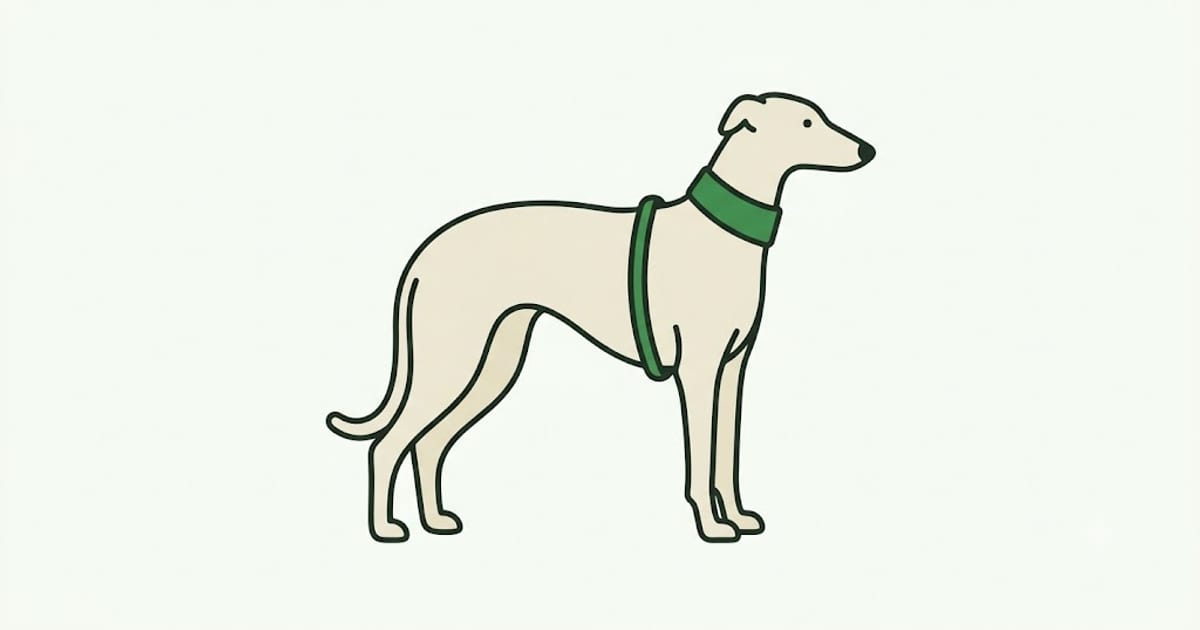
Some dogs can walk backwards out of a correctly fitted collar in about two seconds. Owners usually respond by tightening it, then tightening it again, and end up with a collar that is both uncomfortable and still not safe.
The problem is not the fit. It is the shape of the dog.
Why it happens
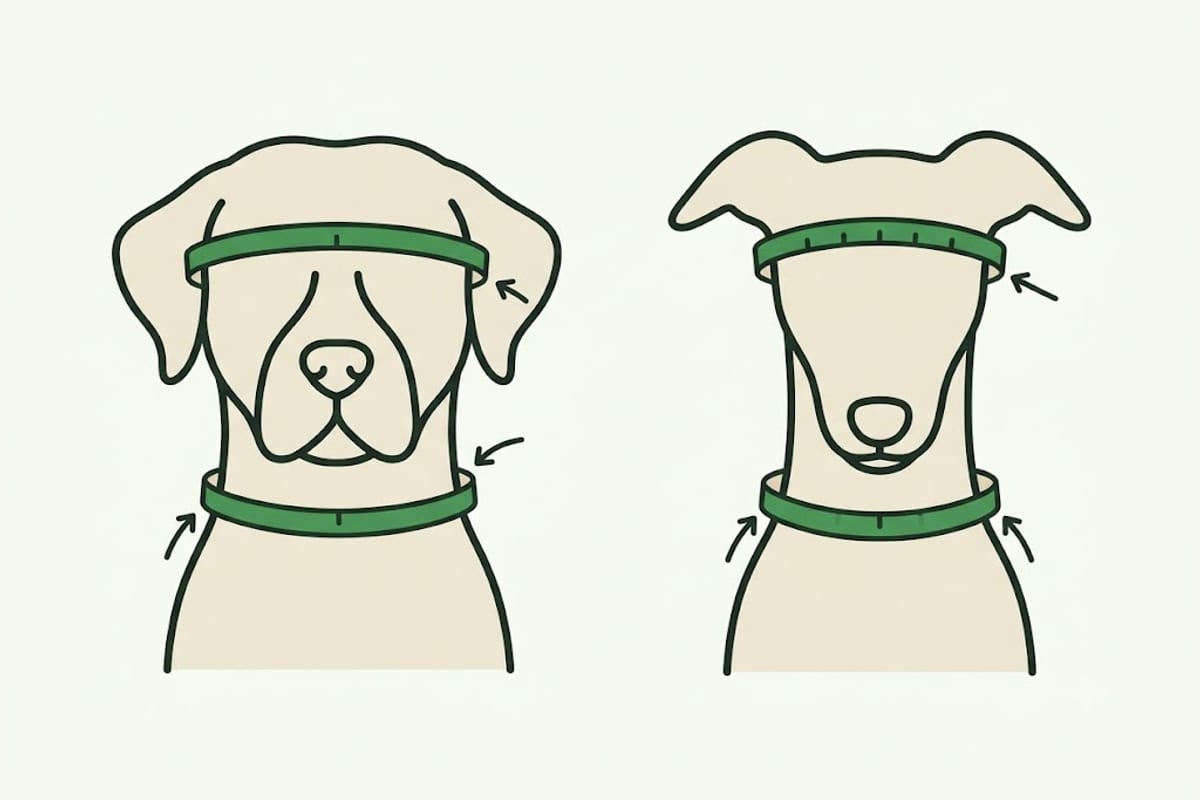
On most dogs, the widest part of the head — across the cheekbones, just behind the ears — is wider than the neck. A collar sized to the neck therefore cannot pass forward over the skull. The head acts as a stop.
On sighthounds, that relationship is reversed. A whippet, greyhound, saluki, borzoi or Italian greyhound has a long, narrow skull sitting on a deep, muscular neck. The neck at its base can be several inches larger than the head at its widest.
A flat collar fitted properly at the neck is, by definition, larger than the head. When the dog plants its feet and reverses, the collar slides forward and comes off.
It is not only sighthounds. Some other narrow-headed breeds and many individual dogs of any breed have enough of this shape to matter, and a dog with a thick winter ruff can lose the margin when the coat blows out.
Why tightening does not work
To hold a flat collar on such a dog you would have to close it below the size of the head — which on a sighthound means well below the natural size of the neck.
That is not a snug collar. It is a collar sitting on the windpipe, and on a breed with a long neck and thin skin it will cause damage over time. Sighthound owners will tell you the same thing: a flat collar tight enough to stay on is tight enough to hurt.
What a martingale does
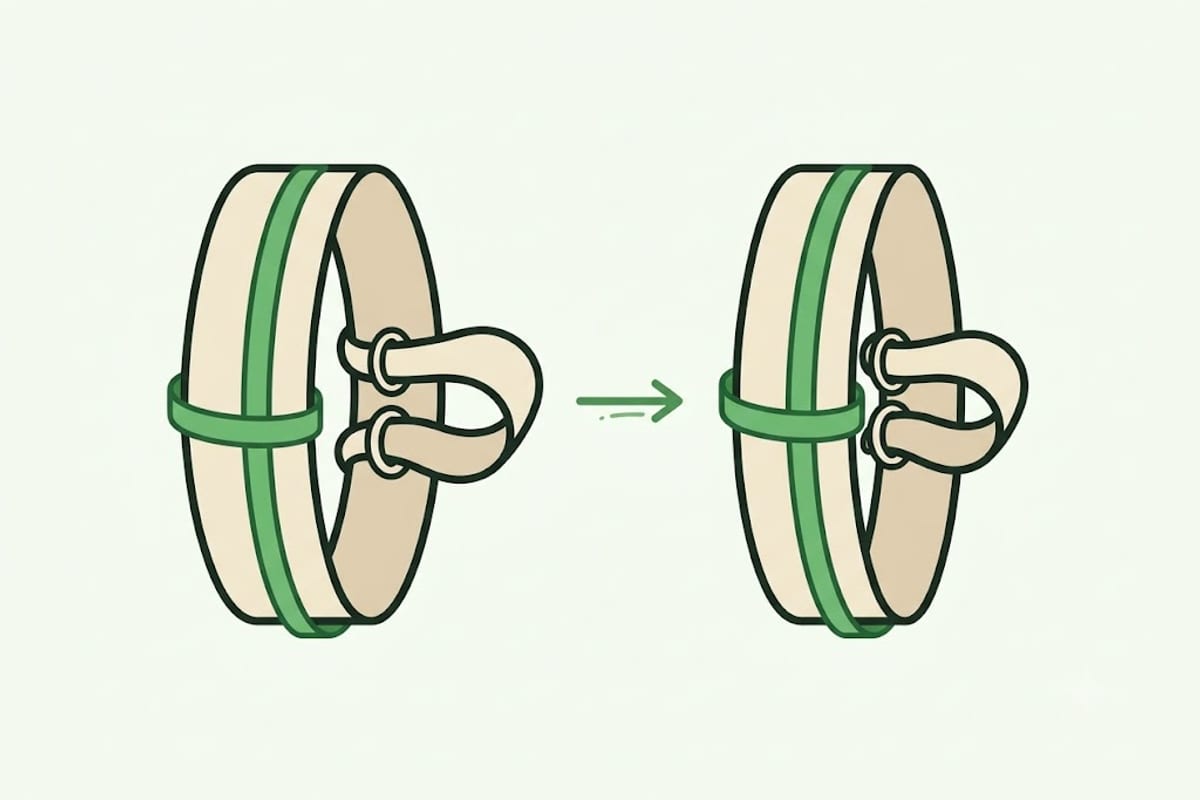
A martingale has two parts: a main band that sits loose around the neck, and a smaller control loop joined to it by two rings, with the lead clipping to the control loop.
At rest the main band hangs comfortably — you can slide it around, the dog is not being held by it. When the lead goes taut, the control loop pulls the two ends of the main band toward each other and the collar closes.
The important part is that it closes to a limit. A properly adjusted martingale tightens only until the main band reaches the dog's neck measurement, then stops. It cannot keep closing the way a slip lead can.
That gives you the thing a flat collar cannot: loose when nothing is happening, snug exactly when the dog is trying to reverse out of it.
Adjusting a martingale
There is one adjustment that matters, and most people set it wrong.
Fully closed, the two rings on the control loop should not touch. Leave a gap of roughly two to three finger widths between them when the collar is drawn tight.
- If the rings meet, the collar has run out of travel before it has closed enough, and the dog can still back out.
- If there is a large gap left when the collar is already tight on the neck, it has closed too far and is squeezing.
Check this with the collar on the dog, pulling the control loop by hand rather than by yanking the lead.
Fitted, not tightened, is the resting state. A martingale should hang loosely enough to move a little when the dog is just standing.
Wide is not decoration
Traditional hound collars are wide — often two inches or more — for a reason. A given amount of lead tension spread across two inches of leather is a fraction of the pressure of the same force through a half-inch strap.
Sighthounds have long necks, thin skin and, in some cases, less muscle padding over the trachea than a thick-necked breed. Width is a real safety feature on these dogs, not a style choice.
Look for a collar that is wide through the middle and tapers toward the ends, which lets the neck move naturally.
What not to use instead
A slip lead as an everyday collar. It has no stop. It closes as far as the dog pulls.
A choke chain. Same problem, plus a metal edge.
A harness alone, if the dog is a runner. A harness that fits properly is very hard to back out of and is a good choice for many sighthounds — but check it the same way, by trying to reverse the dog out of it before you rely on it.
Measuring for one
Measure the neck at its widest point, which on a sighthound is usually a little lower than you expect — down toward the shoulders rather than up under the jaw.
Then measure the head at its widest point, across the cheekbones with the ears folded back.
The martingale's fully open size should be a little larger than the head measurement, so it goes on and off easily, and its fully closed size should equal the neck measurement. Most adjustable martingales cover both if you set the closed limit correctly.
Write both numbers down. On a growing sighthound they change quickly, and the head measurement is the one people forget to take.