Breed harness charts are genuinely useful for one job: narrowing thirty options to three before you take a tape measure out of the drawer. They are not useful for the job people actually use them for, which is buying a harness without measuring — and the reason is not that the charts are badly made.
The problem with the breed as an index
Take Labradors. A working-line female and a heavy show-line male are both Labradors, and their chest girths can be fifteen centimetres apart. That gap spans two sizes in most manufacturers' ranges.
The variation within a breed is frequently larger than the gap between neighbouring breeds. Any chart indexed on breed alone is therefore reporting the middle of a distribution and hiding the spread. Add the three things breed cannot tell you — age, body condition, and whether the dog is spayed or neutered, all of which move girth — and the chart is answering a question about a population, while you are buying for one animal.
So use a breed chart to shortlist. Then measure.
Measuring, which takes ninety seconds
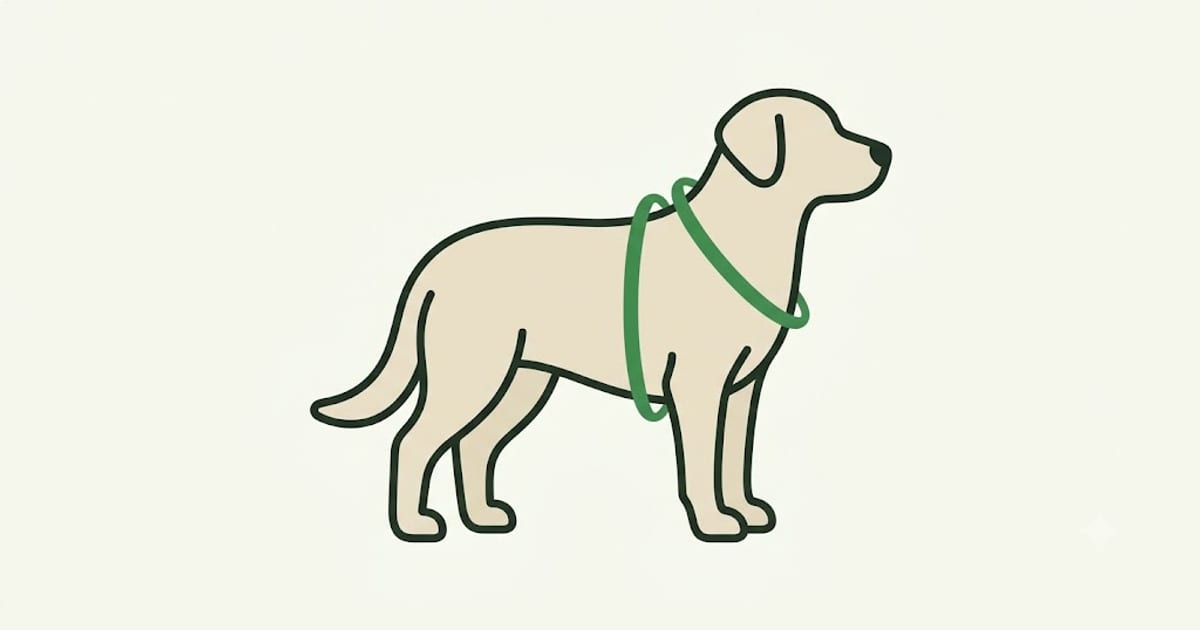
Chest girth is the number. It is measured around the deepest part of the chest, immediately behind the front legs, with the dog standing squarely on all four feet.
Four things that go wrong:
- Measuring while the dog is sitting. The ribcage changes shape. Standing, square, weight on all four.
- Pulling the tape tight. Snug, not compressing. The usual test is two fingers flat under the tape.
- Measuring over a thick coat. On a double-coated dog, part the coat and measure against the body, then decide separately whether you want the harness to fit over winter coat.
- Taking only girth. Girth sizes the harness. Neck circumference decides whether it goes over the head, and on many step-in and overhead designs it is the neck that actually fails.
Take both. Write them down. They are the two numbers every manufacturer's chart is indexed on, and once you have them the charts become directly usable.
Typical girth ranges, for shortlisting only
Approximate adult chest girth ranges. Treat these as a starting point for which sizes to look at, not as a substitute for a tape measure:
| Breed | Typical chest girth |
|---|---|
| Chihuahua | 30–41 cm / 12–16″ |
| Dachshund (standard) | 41–53 cm / 16–21″ |
| French Bulldog | 46–61 cm / 18–24″ |
| Shih Tzu | 41–51 cm / 16–20″ |
| Beagle | 48–61 cm / 19–24″ |
| Border Collie | 56–71 cm / 22–28″ |
| Australian Shepherd | 61–76 cm / 24–30″ |
| Labrador Retriever | 66–86 cm / 26–34″ |
| Golden Retriever | 66–86 cm / 26–34″ |
| German Shepherd | 71–91 cm / 28–36″ |
| Boxer | 66–81 cm / 26–32″ |
| Greyhound | 66–79 cm / 26–31″ |
| Rottweiler | 81–102 cm / 32–40″ |
| Great Dane | 86–110 cm / 34–43″ |
Look at the width of those ranges. Most of them span two or three manufacturer sizes. That is the honest state of breed-indexed sizing, and any chart presenting a single number per breed has simply chosen not to show you the spread. Breed standards from bodies such as the AKC describe proportion and structure rather than the girth measurement harness makers use, which is part of why no authoritative girth table exists.
Why weight-based charts fail worst
Many harness charts are indexed on weight. Weight is the worst available proxy, because girth depends on skeletal shape and weight does not.
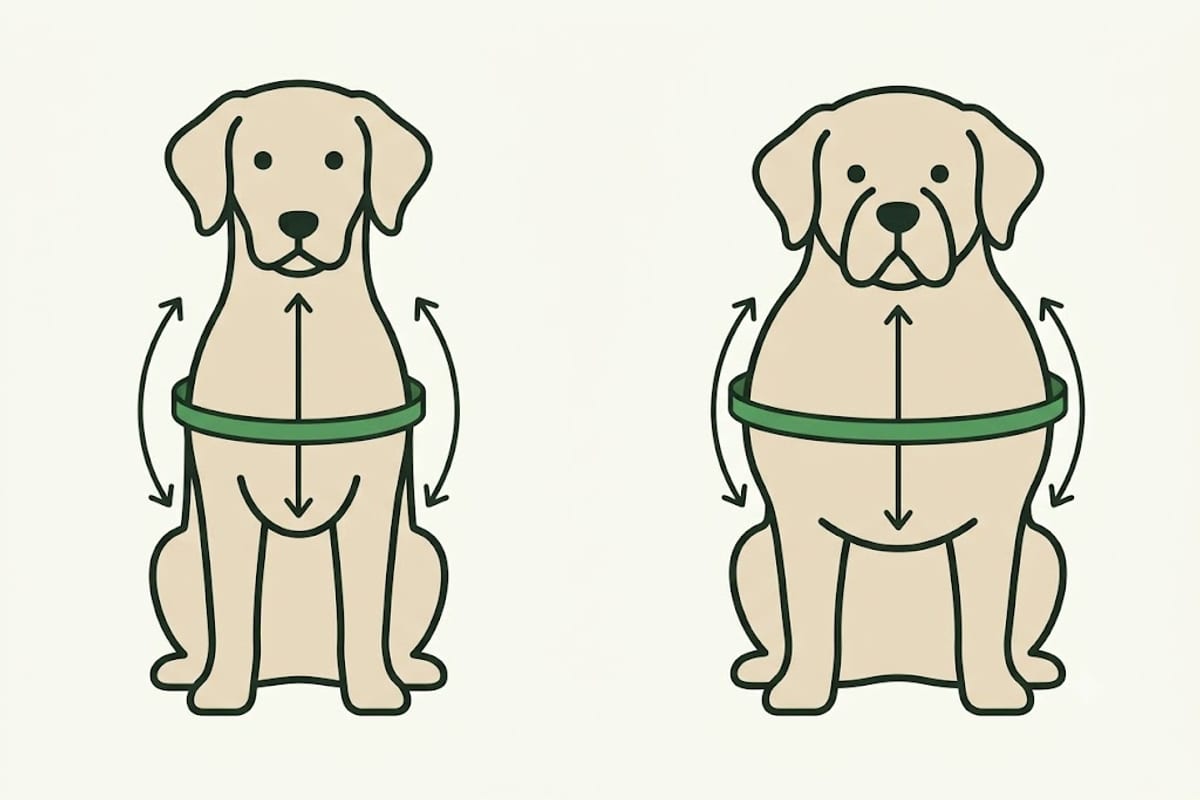
Two dogs at 25 kg:
- A Greyhound — deep, narrow chest, dropping low between the legs. Large girth, minimal body width, and a neck nearly as wide as the skull.
- A Bulldog — broad, barrel chest, wide across the ribs but not deep. Similar girth on a completely different shape.
The same girth number on those two dogs needs different harness geometry, and the strap that sits comfortably on one presses into the other's armpit. That is why a chart with a weight column and no girth column will mis-size a meaningful fraction of dogs, and why it mis-sizes the same breeds every time.
Two shapes deserve specific warnings:
- Deep-chested breeds (Greyhounds, Whippets, Dobermans, Setters) have a chest circumference far larger than their neck. Overhead-style harnesses sized to the chest often will not tighten enough at the neck, and the dog reverses out. Look for designs with an adjustable neck or a back-fastening opening.
- Breeds whose neck is as wide as their head (Pugs, Bulldogs, many terriers) have the opposite problem. Anything sized to slip over the head is then loose everywhere else. Step-in or fully unbuckling designs solve it.
Fit check, after it arrives
A harness that measures correctly can still sit wrong.
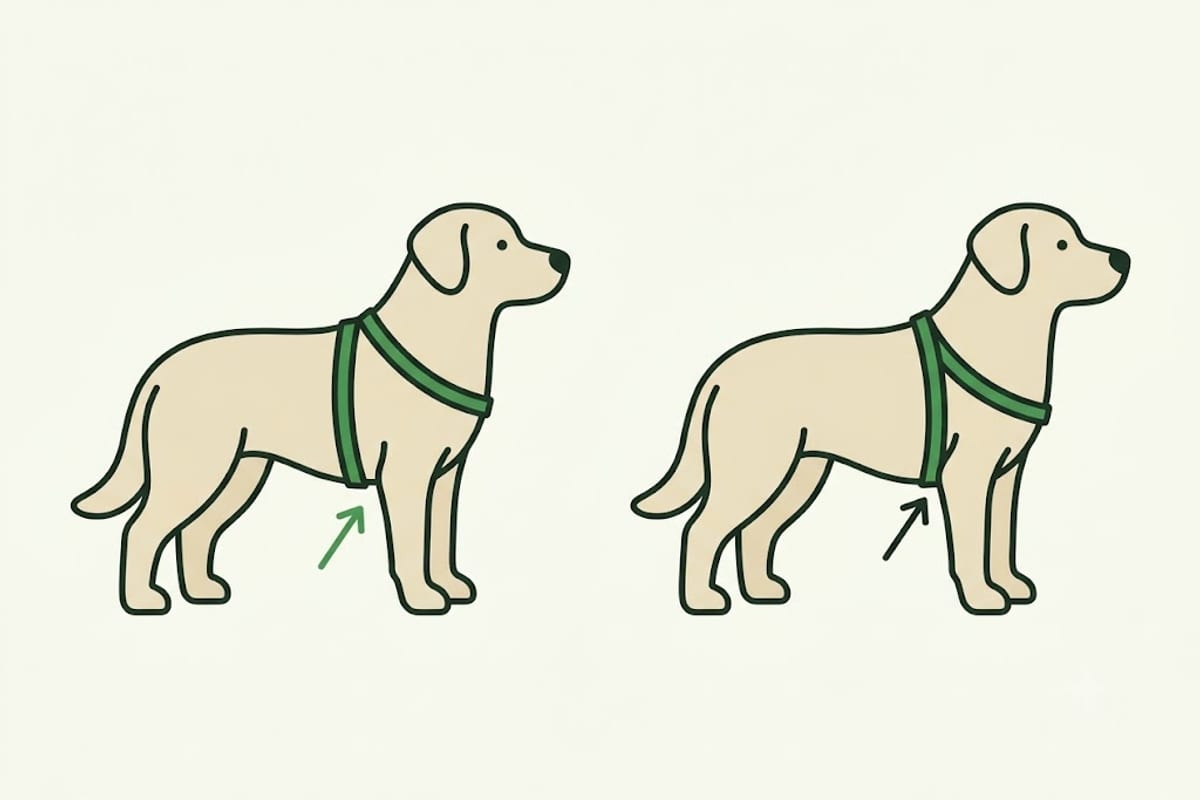
- Two fingers flat should slide under every strap. If you can only get one, it is tight; if your whole hand fits, the dog will back out of it.
- Nothing in the armpit. The chest strap must sit clear behind the front leg. A strap that rides into the crease chafes on every stride, and it is the most common cause of a dog that suddenly hates a harness it wore happily for a month.
- Watch it move. Walk the dog and look at where the straps sit after fifty metres, not where they sat when you fastened them. Straps migrate.
- Full range of motion. The front legs should reach forward without the harness restricting the shoulder.
Growing puppies
Buying a harness a puppy will "grow into" produces a harness that fits badly now and probably never fits properly. Growth is not proportional — a puppy's chest deepens and broadens on a different schedule from its height, so a harness sized for a predicted adult girth sits wrong through the whole growth period.
Buy for the dog you have, expect to replace it, and remeasure every six to eight weeks through the first year. Highly adjustable harnesses stretch the useful life of one purchase further than buying big does.
What this page does not cover
- This is about sizing gear, and nothing else. Nothing here is veterinary guidance. Body condition, weight management and any health question belong with your vet.
- Girth ranges are typical, not authoritative. They are for shortlisting. The manufacturer's own chart, read against your own measurements, is the only sizing that counts.
- Harness style is a separate decision from size — front-clip, back-clip, dual-clip and no-pull designs suit different dogs and different problems.
- Collar and crate sizing use different measurements. A collar is sized on neck circumference; a crate on standing height and body length.
Breed gets you a shortlist. A tape measure gets you a harness that fits.
Read next
- French Bulldog Harnesses: Why the Chart Almost Always Reads Small — The French Bulldog is the breed weight-based charts get most wrong, because almost none of its….
- Measuring a Dog for a Harness: Three Numbers, Ninety Seconds — Girth sizes the harness.
- No-Pull Harness Sizing: Why Fit Decides Whether It Works at All — A front-clip harness is the one style where fit is not a comfort question.
- Puppy Harness Sizing: Why Age Is the Worst Index of All — Age tells you less about a puppy's chest than any other variable, because two puppies of the same age can….