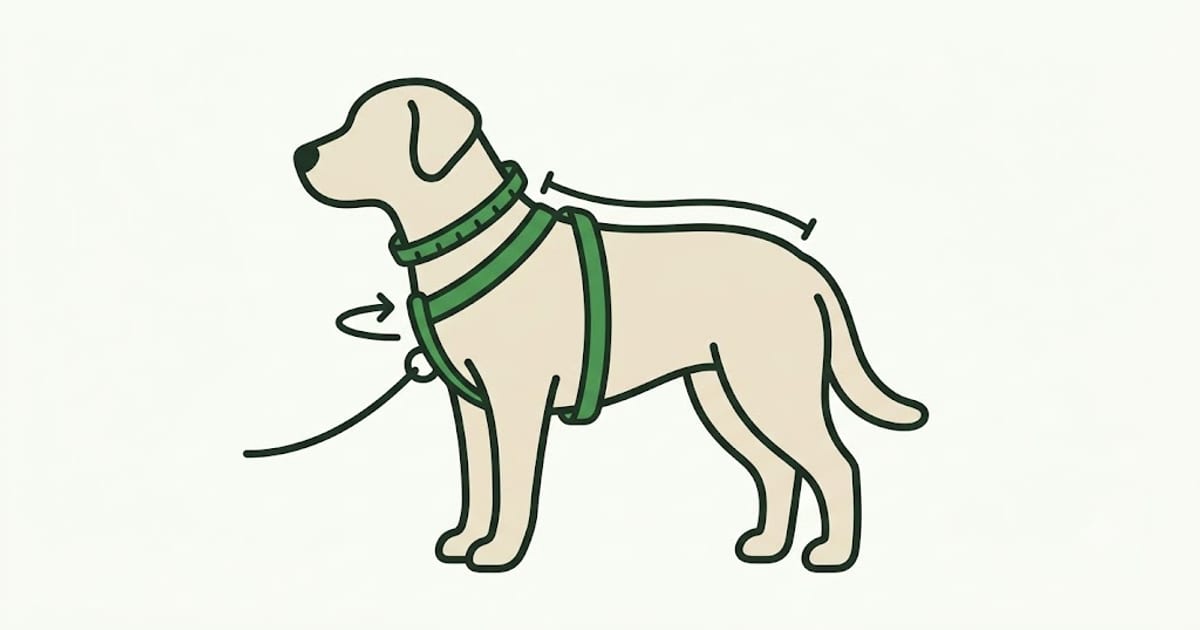
A no-pull harness is the one style where sizing is not mainly about comfort. The mechanism depends on the chest piece staying in a specific place, and a harness that is half an inch loose does not work less well — it stops working.
General sizing is on the harness sizing page, and how to measure is here.
How the front clip works
The lead attaches at a ring on the centre of the chest, rather than on the back. When the dog pulls forward, the lead is off to the handler's side, so the pull turns the dog's chest toward the handler rather than letting it drive straight ahead.
That redirection is the entire mechanism. It is not restraint and it is not discomfort — it removes the leverage the dog uses to pull, by turning the body slightly off the direction of travel.
Everything about sizing follows from one requirement: the chest ring has to stay at the centre of the chest.
Why looseness breaks it
If the harness can rotate around the dog's body, the ring migrates off-centre. Once it is sitting on the shoulder or under the armpit:
- The pull no longer turns the dog, because the ring is no longer on the axis it needs to be on.
- The lead runs across or under a front leg, which is both ineffective and a tangling hazard.
- The harness twists further with every pull, so the problem compounds during the walk rather than staying constant.
A loose back-clip harness is merely a loose harness. A loose front-clip harness is a back-clip harness with the ring in the wrong place.
Sizing this style
Same three measurements as any harness — girth, neck, topline — but two additional constraints:
Go snug, not roomy. Two fingers flat under every strap is the standard, and for a front-clip you want it to be a genuine two fingers rather than a comfortable three. Any more and it rotates.
When between sizes, prefer the smaller if it adjusts up far enough, which is the opposite of the usual advice. A slightly small harness with adjustment left is stable; a slightly large one is not.
Check the adjustment range, not just the size band. Two harnesses labelled "medium" can have very different ranges, and what matters is whether yours can be tightened to your dog's actual girth with room left in the buckle.
The fit checks specific to this style
- Ring at the centre of the breastbone. Not on the shoulder, not up at the throat.
- Chest strap horizontal. If it sits at an angle, the harness is already rotating.
- Nothing in the armpit. The girth strap must clear the elbow, and a snug front-clip is more likely to sit forward than a loose back-clip.
- Walk it and look again. Fifty metres, then check the ring is still centred. This is the check that matters, and it is the one nobody does.
- Pull test. Take up the lead as the dog would and see whether the body turns. If it does not, the ring has moved or the harness is too loose.
Y-front versus straight-across
Two common front-piece geometries:
Y-front — the chest piece forms a Y over the breastbone, leaving the throat clear and the shoulders free. Better for shoulder movement and better for any dog with a compromised airway.
Straight-across — a single strap running horizontally across the front of the chest. Simpler, and it sits higher. On a dog that pulls hard it can press across the front of the shoulders and, on some conformations, up toward the throat.
For a harness whose entire purpose is to be used on a dog that pulls, the Y-front is generally the better geometry, because the load arrives while the dog is pulling and that is exactly when a straight-across strap presses hardest.
What the harness does not do
Worth being plain about: a no-pull harness is equipment, not training. It reduces the mechanical advantage a dog has while wearing it. It does not teach the dog anything by itself, and most dogs pull just as hard the moment it comes off.
Used as a management tool while training happens separately, it is genuinely useful. Used as a substitute for training, it is a thing you will still be using in three years.
What this page does not cover
- Measuring technique is on the measuring page.
- Head halters and other equipment work by different mechanisms with different fitting rules.
- Training method, which is the part that actually changes the behaviour.
- Anything veterinary — gait, joints and shoulder movement concerns belong with a vet.
Snug, centred, and check it again after fifty metres.