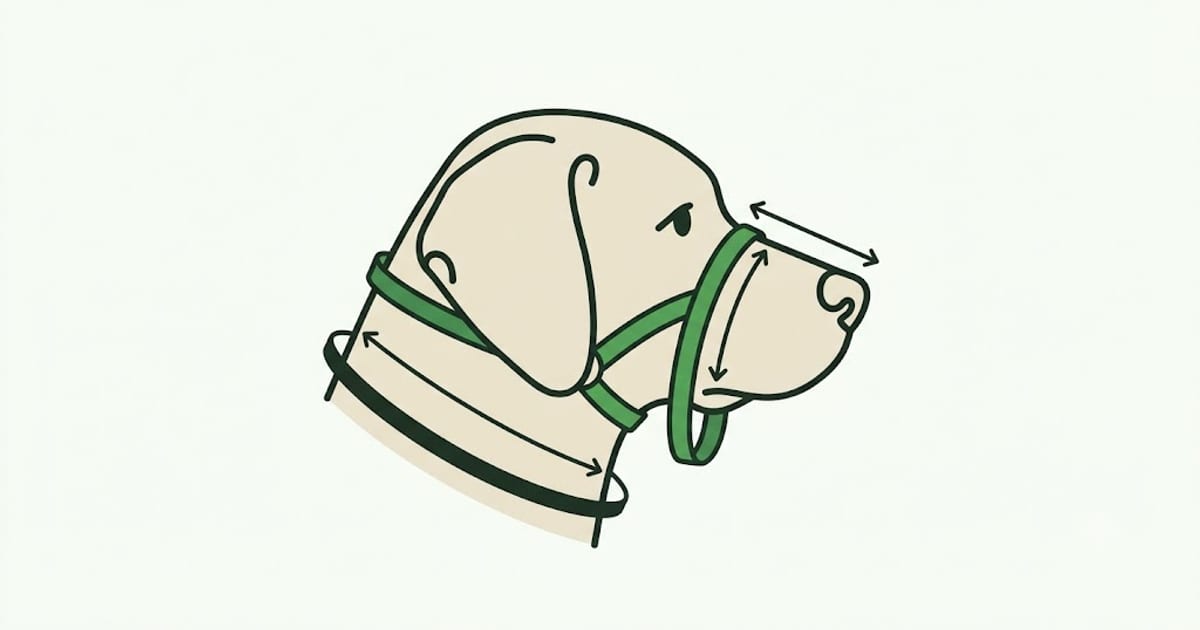
A head halter turns the dog's head toward you when the lead goes tight, which is why it gives so much control on a strong dog. It is also the piece of equipment owners give up on fastest, and almost always for one of two reasons: it was fitted wrong, or it was put straight on the dog and used.
Sized on the muzzle, not the neck
Head halters are sized by muzzle circumference and by head shape, not by the dog's weight or neck. Two dogs of the same weight can need different sizes if one has a broad blocky muzzle and the other a fine one.
Measure around the muzzle roughly an inch below the eyes, with the mouth closed. That is where the nose loop sits.
Many makers also publish a breed guide. Use it as a starting point only — muzzle shape varies enormously within a breed, and the difference between a working line and a show line is often a whole size.
Getting the fit right
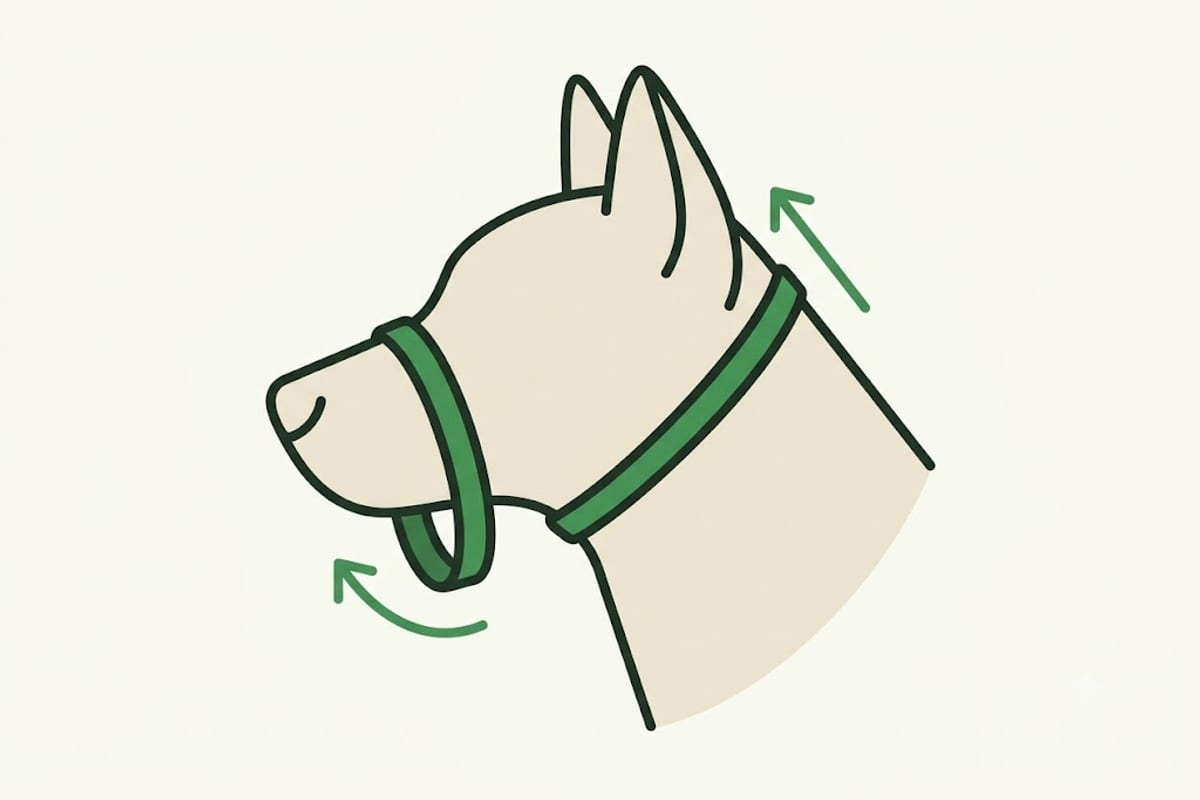
Two settings, and both are commonly wrong.
The neck strap must sit high, right behind the ears, and be snug. This is the strap people leave too loose. If it slides down the neck, the whole halter shifts forward, the nose loop drops toward the end of the muzzle, and the dog can paw it off. Snug here means you can get one finger under it, not two.
The nose loop must be loose. This is the strap people make too tight. The dog should be able to open its mouth fully, pant, drink and take a treat while wearing it. The loop is there to steer, not to hold the mouth closed. If it is tight enough to restrict the jaw, the dog will fight it and will be right to.
A correctly fitted halter looks slightly odd — snug at the back, visibly loose at the front. That is the correct look.
Introducing it
This is the step most owners skip, and skipping it is why most halters end up in a drawer.
A dog that has a strange loop put over its nose and is then walked with it will spend the walk pawing, rubbing its face on the ground and refusing to move forward. It learns that the halter means discomfort, and that lesson is hard to reverse.
A workable introduction takes several short sessions over several days:
- Show the halter, feed a treat. Repeat until the dog is pleased to see it.
- Hold the nose loop open, let the dog put its nose through to reach a treat. Do not fasten it. Repeat.
- Fasten it for a few seconds, then take it off while the dog is still comfortable. Build up.
- Wear it indoors with no lead attached, during something enjoyable.
- Attach the lead indoors, then in the garden, then on a walk.
If at any stage the dog starts pawing, you have moved too fast. Go back a step.
Always use a safety connection
A head halter should never be the only thing connecting you to the dog.
Standard practice is a short connector strap from the halter's ring to the dog's collar or harness ring, so that if the halter comes off or the dog slips it, the dog is still on the lead. Many halters include one; if yours does not, a short carabiner-and-strap does the job.
Attach the lead to the halter, and the safety strap between halter and collar.
Handling the lead differently
A head halter changes what a hard correction does. Because it turns the head, a sudden jerk on the lead can wrench the dog's neck.
That means:
- Never jerk or snap the lead when a halter is on
- Keep the lead short but slack, guiding rather than pulling
- Do not use a long line or a flexi with a halter — a dog hitting the end of a running line while wearing one can be injured
Some trainers avoid halters for exactly this reason on strong dogs that lunge. That is a defensible position and worth knowing about before you buy.
When not to use one
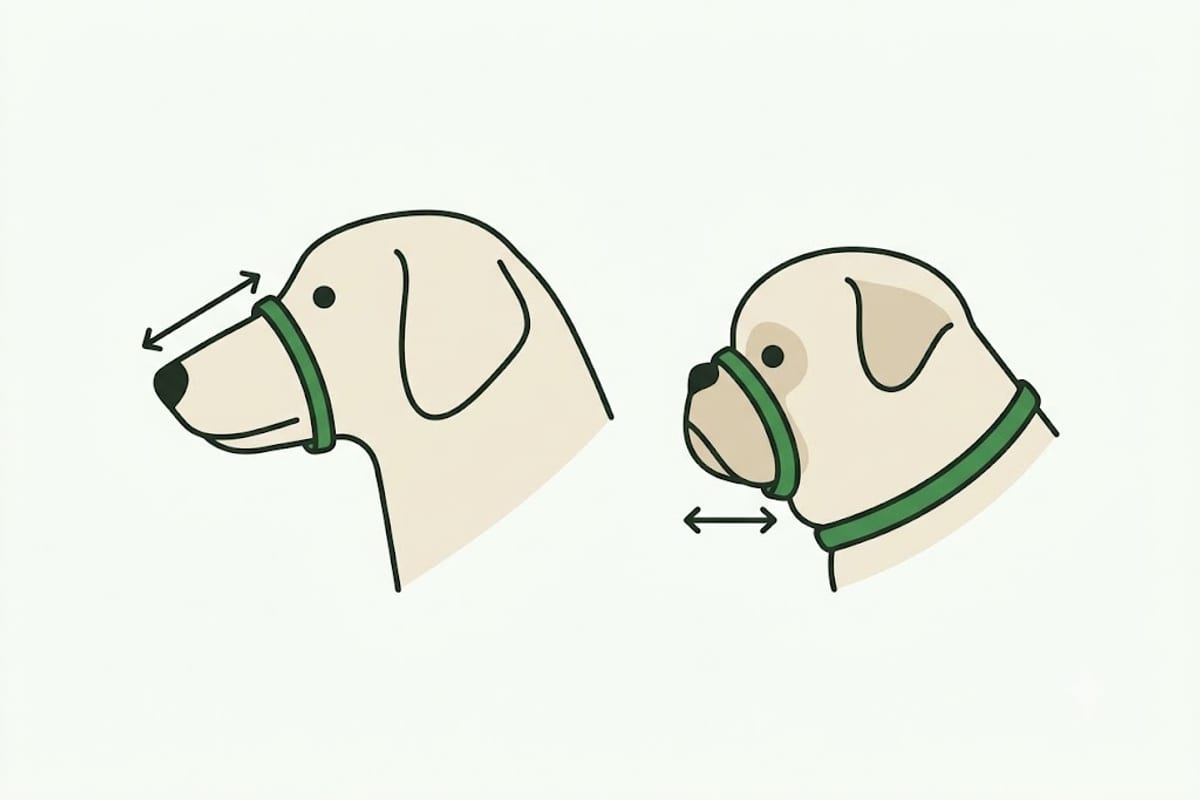
Flat-faced breeds. Pugs, French bulldogs, boxers and similar have no muzzle length for the nose loop to sit on. It slides straight into the eyes or off the nose. There are specialist designs for short-faced dogs, but a standard halter does not work.
Dogs with existing neck or spinal issues. The steering action puts a twisting load on the neck. If a dog has a diagnosed neck problem, this is a question for the vet, not a fitting decision.
Off-lead or dragging. A halter should never be left on an unsupervised dog, and never used on a line the dog can run to the end of.
As a substitute for training. A halter manages pulling; it does not teach loose-lead walking. Dogs generally still pull when it comes off. Used alongside training it is a useful tool; used instead of training it is a permanent one.
Signs of a bad fit
- The dog paws at its face repeatedly after the introduction period
- The nose loop slides down toward the end of the muzzle
- Rub marks on the bridge of the nose or under the jaw
- The dog cannot pant comfortably while wearing it
The first three are fit. The fourth is a nose loop that is far too tight and should be loosened before the next walk.