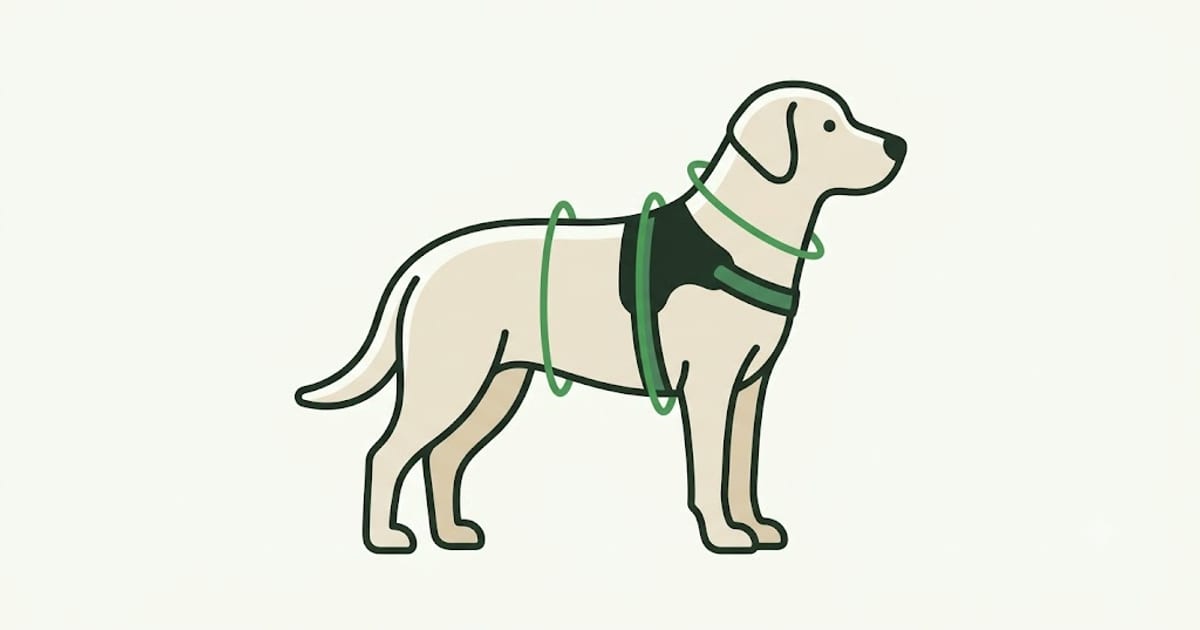
Chafing from a harness almost always shows up in the same place: the soft, thin-skinned area behind the front leg, where the leg meets the chest. Owners usually blame the fabric and buy a padded harness. That rarely helps, because padding a strap that is in the wrong place just makes a thicker strap in the wrong place.
Why that spot
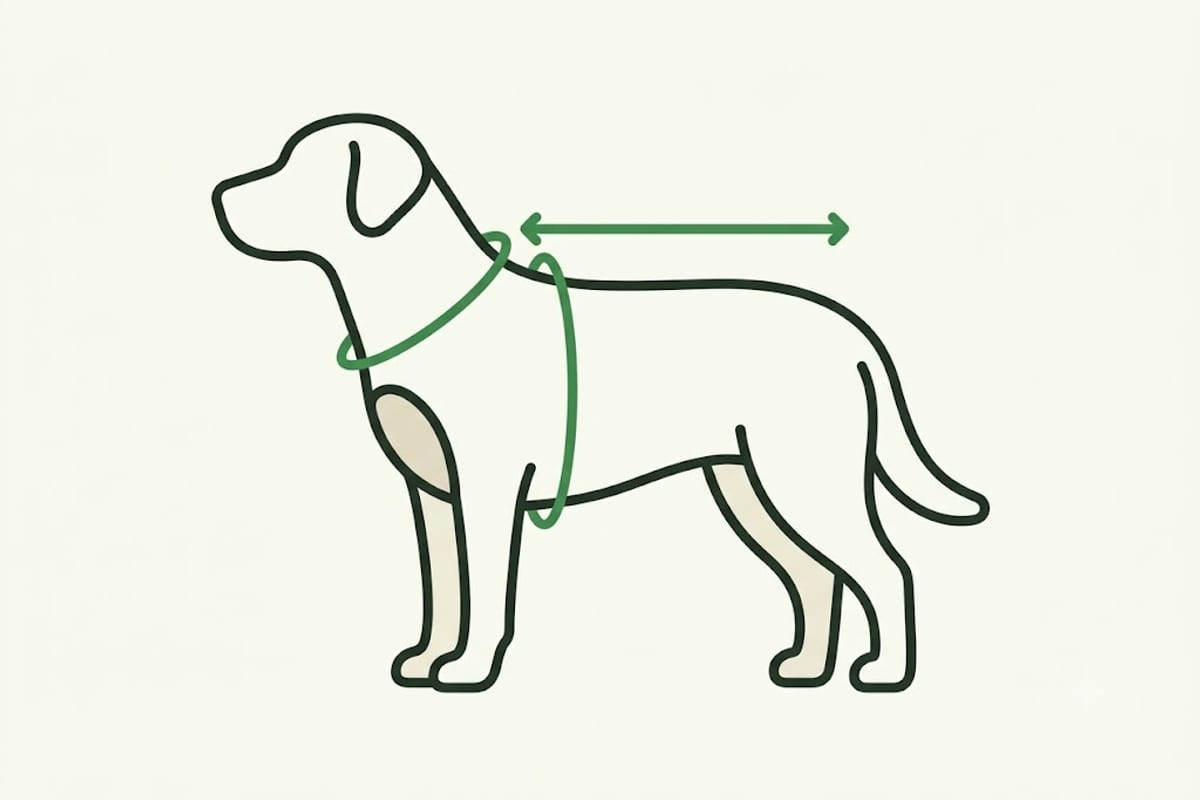
Three things meet there at once:
Thin skin with little coat. On most dogs this area has sparse hair and no protective layer.
Constant movement. The leg swings through a large arc at every stride. A strap sitting against the leg gets a rubbing cycle with every step — thousands per walk.
A natural crease. Skin folds there, and a strap sitting in the fold traps moisture and grit.
Any strap that lies against that area will rub, regardless of how soft it is.
Finding the actual rub point
Put the harness on and look from the side while the dog stands square.
Then walk the dog a few steps and watch the rear strap — the one that passes around the chest behind the front legs. You are looking for whether it stays clear of the leg through the stride or contacts it.
Feel the skin after a walk. Warm, pink, or damp in a defined line tells you where. Broken hair in a stripe tells you it has been happening for a while.
The three real causes
1 — The strap sits too far forward.
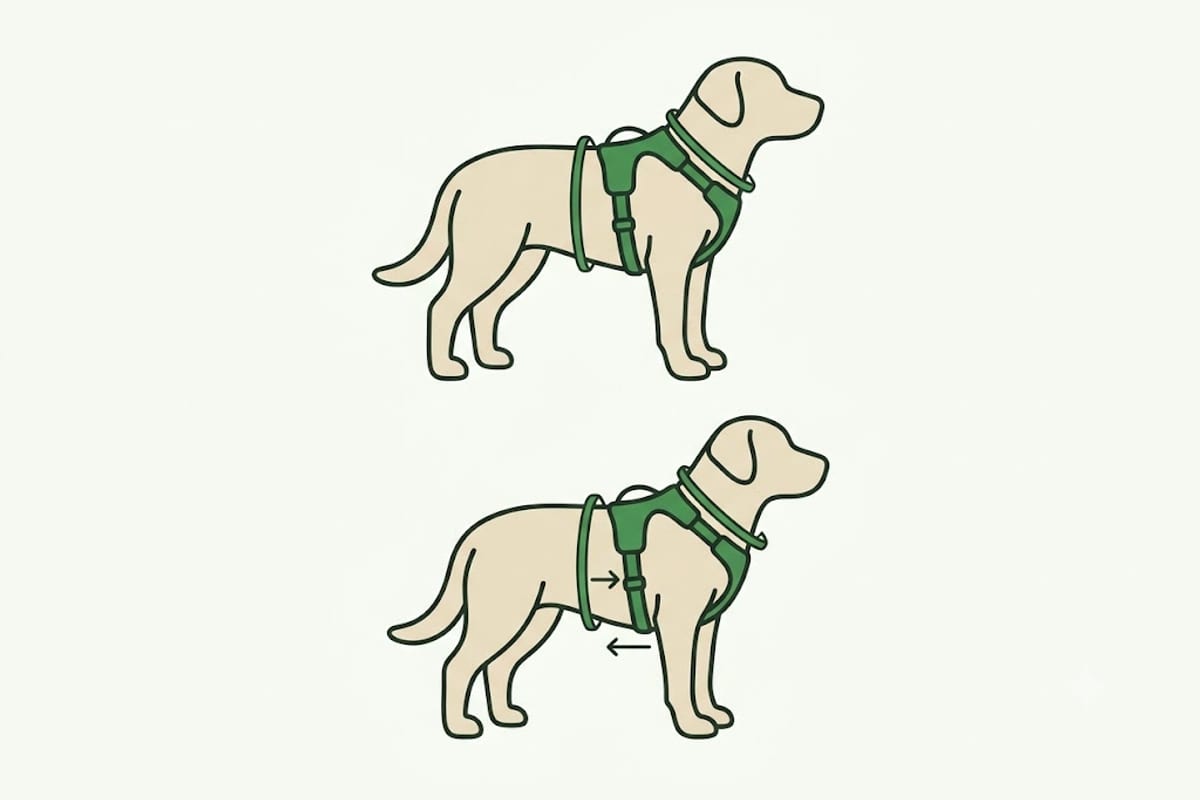
This is the most common. The rear strap should sit clearly behind the elbow with room for the leg to swing — a rough guide many fitters use is about two finger widths of clearance behind the elbow.
A harness that is too short front to back pulls that strap forward into the leg. No adjustment will fix it; the harness is the wrong shape for the dog. Longer-bodied dogs and deep-chested dogs run into this most.
2 — It is too tight.
A harness that is over-tightened presses the strap into the skin instead of letting it ride on the coat. The two-finger check applies here too: you should be able to slide two flat fingers under every strap, including the one behind the legs.
Over-tightening is usually a response to the harness twisting or slipping. Tightening treats the symptom; the cause is normally the wrong size or the wrong shape.
3 — It is too loose and moving.
The opposite failure. A harness that slides side to side with each stride drags across the same skin repeatedly. Here the rub is often on both sides and less sharply defined.
What fixes it
Re-fit before re-buying. Most harnesses have three or four adjustment points and most owners only ever use one. Loosen everything, put it on, and set each strap in turn, starting at the chest.
Change the harness shape, not the padding. If the rear strap will not clear the elbow at any setting, you need a harness with a longer body — often described as having a "Y-front" or a longer sternum panel. On a deep-chested dog this is usually the answer.
Check what is under the strap. Grit, dried mud and matted coat under a strap are abrasive. On a long-coated dog, a mat sitting under the girth strap will take hair off in a week.
Let the skin heal before going back to it. Once the skin is broken, any harness will irritate it. Use a collar for short lead walks for a few days if it is safe to do so, and give the area a chance to close.
Things that do not fix it
A padded harness with the same geometry. Padding adds bulk in the same place. Sometimes it makes the fit tighter and the rubbing worse.
A fleece sleeve over the strap. Better than nothing, but it is a workaround for a strap that should not be touching the leg.
Loosening only the rear strap. That usually lets the whole harness rotate, which spreads the rubbing rather than stopping it.
When it is not the harness
If the skin behind the elbow is irritated and the dog does not wear a harness, or the irritation extends beyond the strap line, the harness is not the cause. Allergies, mites and yeast all show up in the same warm folded areas. That is a question for a vet, not a fitting problem.
After a fitting change
Give it a short walk, then check the skin. Then a normal walk, then check again. Chafing builds over distance, so a harness that seems fine after ten minutes can still rub on an hour-long walk.
Re-check after any coat change, any weight change, and on any harness that has been washed — webbing can shrink slightly, and the setting you had is not always the setting you have.