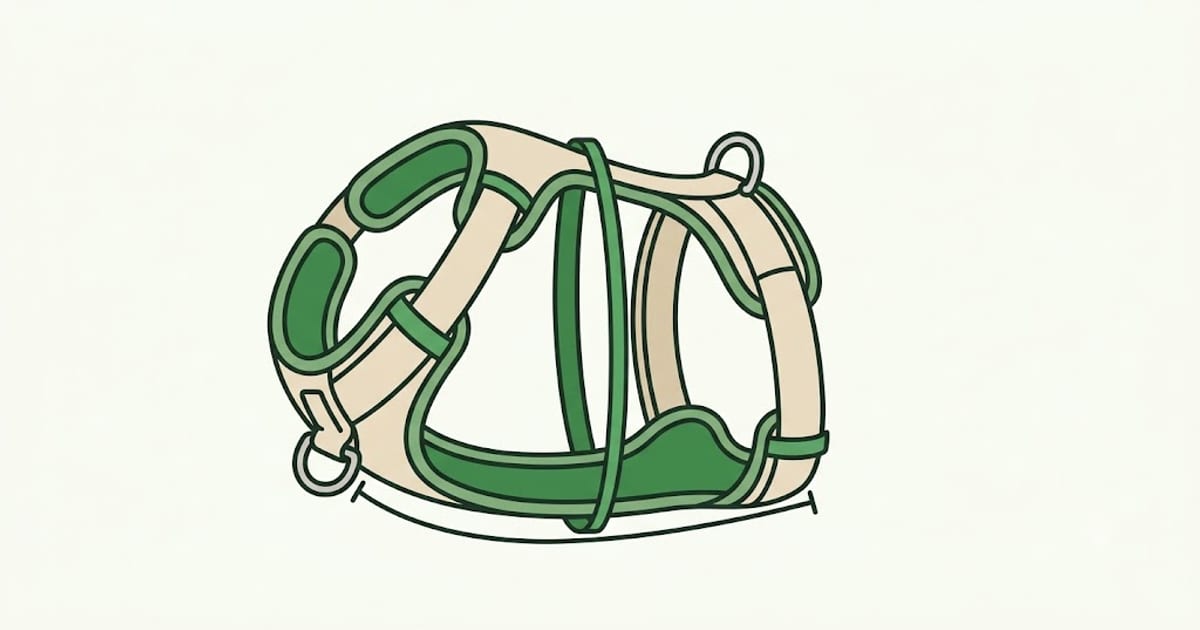
The attachment point changes the physics, not the comfort.
Back-clip — lead attaches between the shoulder blades. The dog pulls forward, you pull backward, and the forces are directly opposed. Comfortable, simple, and it gives you no directional control whatsoever.
Front-clip — lead attaches at the chest. When the dog pulls forward, the lead pulls the chest sideways and the dog turns back toward you. Momentum works against the pulling rather than with it.
Why back-clip can make pulling worse
Dogs have an opposition reflex: pressure from behind produces forward pressure in response. It is the same instinct that makes sled dogs pull harder into a harness, and sled harnesses are back-clip by design.
So on a dog that already pulls, a back-clip harness can genuinely reinforce the behaviour. That is not a manufacturing fault; it is what the geometry does.
For a dog that walks nicely, none of this matters and a back-clip is the more comfortable option.
What front-clip does and does not do
It reduces the effectiveness of pulling. It is not a training method on its own — it makes pulling less rewarding while you teach loose-lead walking, and a dog can learn to pull through one.
Check the shoulder. Some front-clip designs place the chest strap where it restricts the shoulder's forward reach, which is a real concern on long walks and for dogs that run. The test is in fitting a harness: extend a front leg forward and see whether anything stops it.
Watch for the lead crossing under a leg. Chest attachment puts the lead low and forward, and on smaller dogs it tangles.
Dual-clip and double-ended leads
Many harnesses have both rings. A double-ended lead clipped to front and back gives more control than either alone — the front ring steers, the back ring stops, and the two together let you guide rather than restrain.
It is the setup most trainers use for a large dog that pulls, and it is worth the slightly odd-looking lead.
Head halters are a different tool
A head halter attaches at the muzzle, so the head turns and the body follows. More leverage than any harness.
It also needs proper introduction — most dogs object initially — and a sharp pull can wrench the neck. Use with a short lead, never with a long line or a flexi.
Not a beginner's tool, and not a substitute for a correctly fitted harness on most dogs.
Choosing
- Dog walks nicely — back-clip. Comfortable, simple.
- Dog pulls — front-clip, or dual with a double-ended lead.
- Small dog, tangles easily — back-clip, or a front ring positioned high.
- Large strong dog in training — dual-clip with a double-ended lead.
Whichever you choose, sizing comes first — none of this works on a harness that does not fit. See harness sizing by breed.
FAQ
Is a front-clip harness better than a back-clip?
For a dog that pulls, yes — it redirects the dog toward you instead of letting it lean into the lead. For a dog that walks nicely, back-clip is more comfortable.
Do back-clip harnesses encourage pulling?
They can. Dogs have an opposition reflex that responds to backward pressure by pushing forward, which is why sled harnesses attach at the back.
Will a front-clip harness stop my dog pulling?
It makes pulling less effective while you train loose-lead walking. It is a management tool rather than a cure.
What is a double-ended lead used for?
Clipping to both front and back rings at once, which gives steering and stopping together. The usual setup for a large dog in training.
Are head halters safe?
They give a lot of leverage and a sharp pull can wrench the neck. Use with a short lead only, and introduce them gradually.