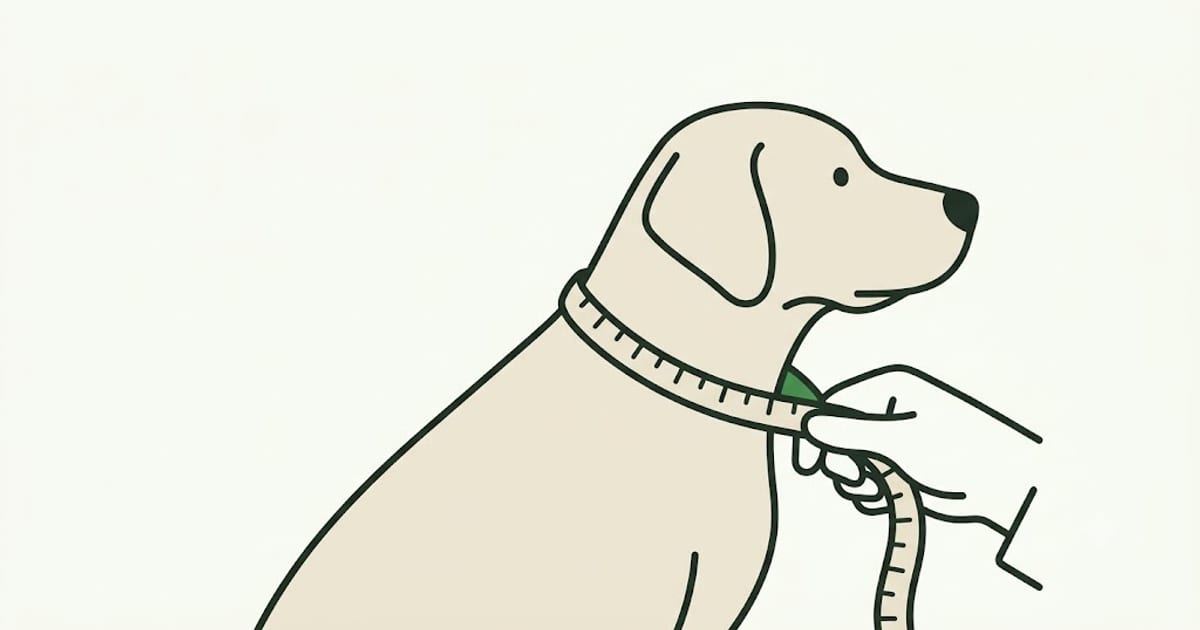
Three steps, and the second one is where most of the error lives.
1. Find where the collar sits. Low on the neck, against the shoulders — not high under the jaw. A collar rides down to this position on its own within minutes of being fitted, so measure where it ends up rather than where you first put it.
2. Wrap the tape against the skin. Not over the coat. This is the big one, covered below.
3. Add two fingers. Slide two fingers flat between tape and neck; that gap is the fit. It works on every dog regardless of size or breed.
Three ways the number reads wrong
Coat. A Pomeranian, Samoyed, Shetland Sheepdog or Bichon carries enough coat to add an inch or more of apparent girth. Measure over it and the collar is genuinely loose against the skin — and that gap is exactly where a startled dog backs out. Part the fur down to skin.
The corollary catches people seasonally: a dog measured before grooming needs re-checking after, and a double-coated breed's fit changes between summer and winter.
Posture. A dog with its head up has a different neck girth than a dog with its head lowered pulling into a harness. Measure with the dog standing normally, head level. If it is straining against the tape, wait.
Growth. Puppies outgrow collars fast enough that a correct measurement expires. Check the two-finger fit weekly during rapid growth — collars can embed as a puppy grows into them, and it happens gradually enough that nobody notices until it is a veterinary problem.
No tape measure
Use a strip of paper or a shoelace. Wrap it, mark where it overlaps, lay it flat against a ruler.
This is often more accurate than a stiff tape, which resists following the curve of a neck and tends to read long.
Reading the size chart
Collars are sold by a range, such as 14–20 inches, because they adjust. Aim to land in the middle of the range rather than at either end.
At the extremes you lose adjustment in one direction, and there is always a direction you end up needing — a puppy growing, a winter coat coming in, a dog gaining or losing weight. A collar at the very top of its range with the buckle at the last hole has nowhere left to go.
Width, and when it is wrong
Width scales with the dog, and the reason is force distribution: a narrow strap concentrates load over a small area.
- Under 10 lb: ½ in
- 10–25 lb: ⅝–¾ in
- 25–55 lb: ¾–1 in
- 55 lb and over: 1–1½ in
Going wider than the range on a small dog does not add safety. A wide stiff collar on a small neck rubs and restricts head movement.
When a collar is the wrong tool
For sighthounds, flat-faced breeds and breeds prone to tracheal collapse, the answer is not a different measurement — it is a different product. Which breeds and why is in collar sizing by breed, and the alternative in harness sizing.
FAQ
Where do I measure a dog's neck for a collar?
Low on the neck against the shoulders, where the collar actually sits — not high under the jaw.
Should I measure over the fur?
No. Part the coat and measure against the skin. Long or double coats can add an inch or more of apparent girth.
How much room should a dog collar have?
Two fingers slid flat between collar and neck. Tighter restricts; looser lets the dog back out of it.
How often should I check a puppy's collar?
Weekly during rapid growth. Collars can embed as a puppy grows into them.
What if my dog is between sizes?
Choose the size where your measurement lands nearer the middle of the adjustment range, so you keep room to move in both directions.