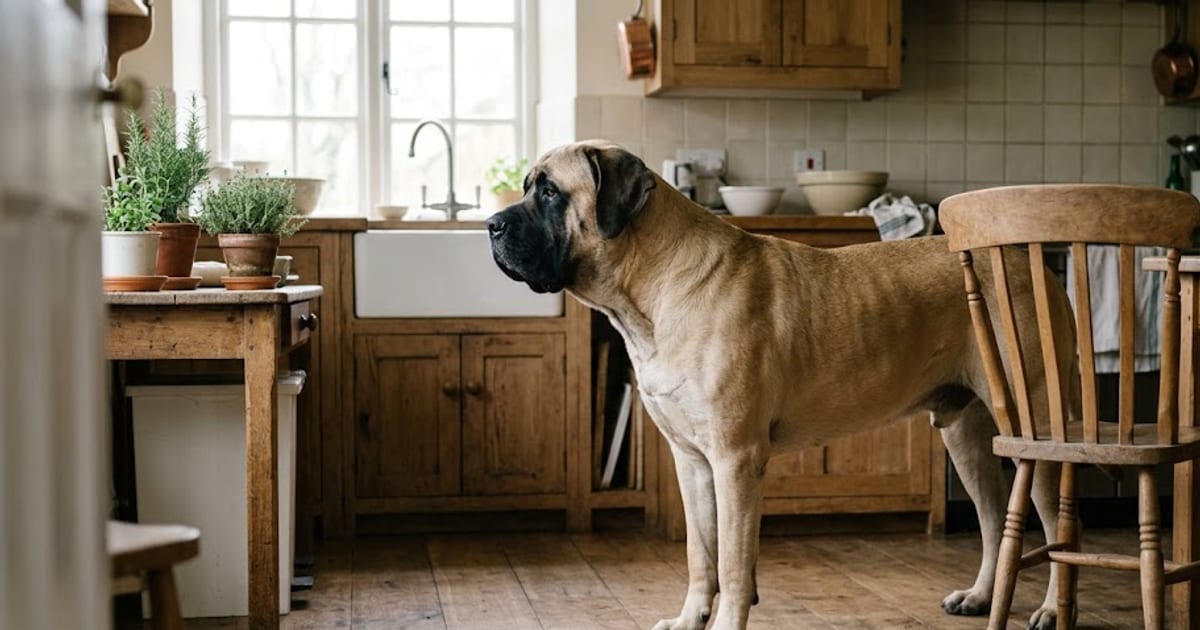
An adult male English Mastiff typically weighs 160 to 230 pounds and an adult female 120 to 170 pounds, according to the AKC's Mastiff breed page. The breed standard itself does not mention weight. It sets only minimum heights: 30 inches at the shoulder for males and 27½ inches for females, with dogs below the minimum faulted.
That makes the Mastiff unusual. There is no upper limit on size in the breed standard, and it asks for a massive, heavy-boned dog with "great depth and breadth". The range owners see in real life is correspondingly wide.
Adult Mastiff size
| Male | Female | |
|---|---|---|
| Weight (AKC guide) | 160–230 lb | 120–170 lb |
| Minimum height (standard) | 30 in | 27.5 in |
| Adult height reached | about 15–18 months | about 15–18 months |
| Adult weight and breadth reached | about 2.5–3 years | about 2.5–3 years |
| Life expectancy (AKC) | 6–10 years | 6–10 years |
Why the range is so wide
A 70-pound spread within one sex looks like a mistake, but it reflects real variation in the breed.
Height varies. The standard sets minimums only, so a 33-inch male and a 30-inch male are both correct. Three extra inches of height on a dog built this deeply adds a great deal of mass.
Bone and substance vary. Mastiff lines differ in how heavy the bone is and how broad the body. Two dogs of the same height can differ by 30 or 40 pounds while both carrying normal amounts of fat.
Age matters more than in most breeds. A Mastiff is not finished at a year old, and a two-year-old can weigh 20 or 30 pounds less than the same dog at three.
How Mastiffs grow
Giant breeds grow for much longer than other dogs, and the Mastiff is one of the slowest. Puppies put on height quickly in the first year. After that the skeleton is almost done, and the dog spends another year or more filling out through the chest, neck, head and hindquarters.
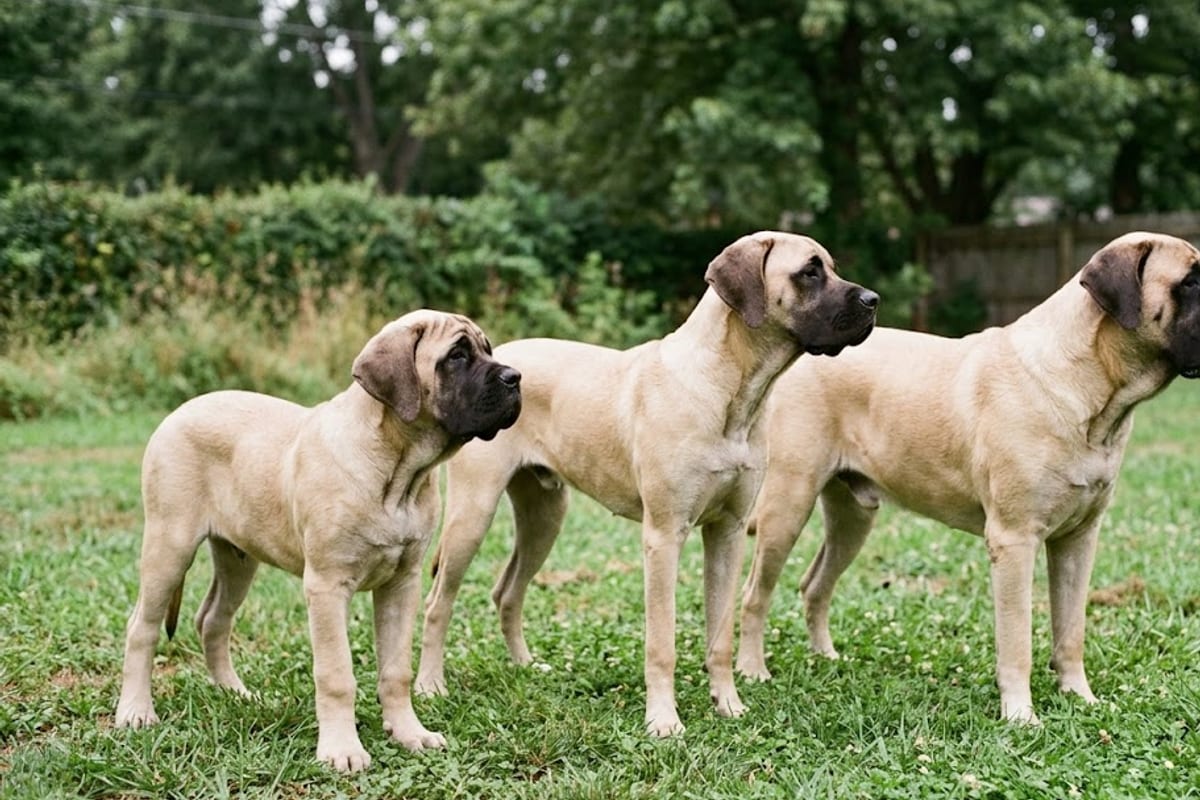
A rough pattern for a male:
- 6 months: often 80 to 100 pounds, all legs, paws and loose skin.
- 12 months: close to adult height, often 130 to 160 pounds, narrow for his height.
- 2 years: heavier and broader, but still maturing in the chest and head.
- 3 years: fully mature.
The Mastiff puppy weight chart at 6 months shows expected weight by age and the share of adult weight a typical puppy has reached.
Why slow growth matters
The most important thing a Mastiff owner can do for the dog's joints is keep the puppy lean. Giant-breed puppies that gain weight too fast are at greater risk of developmental orthopedic disease, including hip and elbow dysplasia and osteochondrosis. Practical steps:
- Feed a food formulated for large-breed or giant-breed growth, which controls calcium and energy density.
- Do not add calcium supplements.
- Keep the puppy at a body condition where the ribs are easy to feel.
- Avoid stairs, repeated jumping and long forced runs until growth is complete.
A lean Mastiff puppy will look thin to people who expect a giant breed to be round. That is fine.
Is your Mastiff the right weight?
A scale is harder to use with a 180-pound dog, and the numbers are less meaningful because of the wide range. Body condition is the better guide.
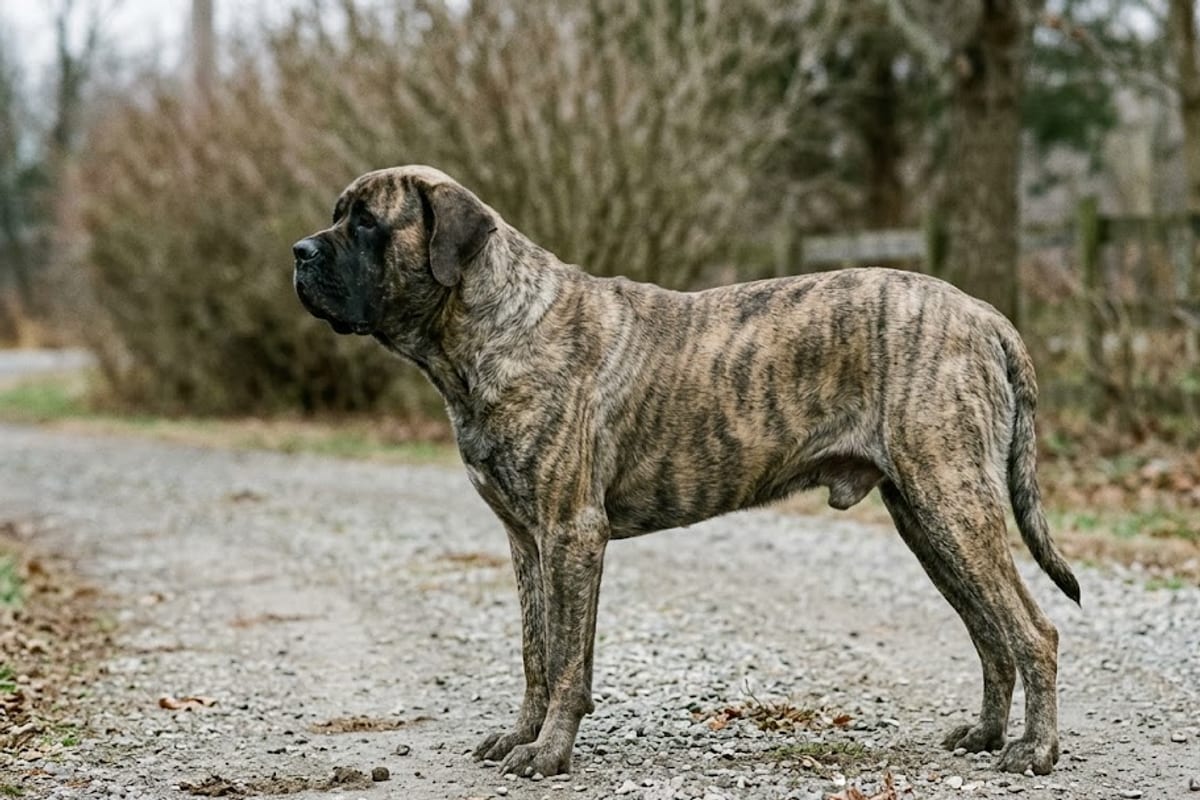
Ribs. Mastiffs have short coats, so run your hands along the chest. You should feel the ribs through a thin layer of fat and muscle. Loose skin can make this confusing; press gently through it rather than pinching it.
Tuck. From the side, the belly should rise a little toward the hind legs. A Mastiff is deep-bodied and will never have the tuck of a Greyhound, but a straight line or a hanging belly means excess weight.
Waist. From above, there should be some narrowing behind the ribs.
On the 9-point body condition score used in the WSAVA Global Nutrition Guidelines, 4 and 5 are ideal. For a 190-pound Mastiff, each point above 5 is roughly 19 pounds of extra weight.
Weight and a Mastiff's health
The AKC lists the breed's life expectancy as 6 to 10 years, short even for a giant breed. Extra weight shortens it further by loading joints that are already under strain, and it makes the heat intolerance of a heavy, short-muzzled dog worse.
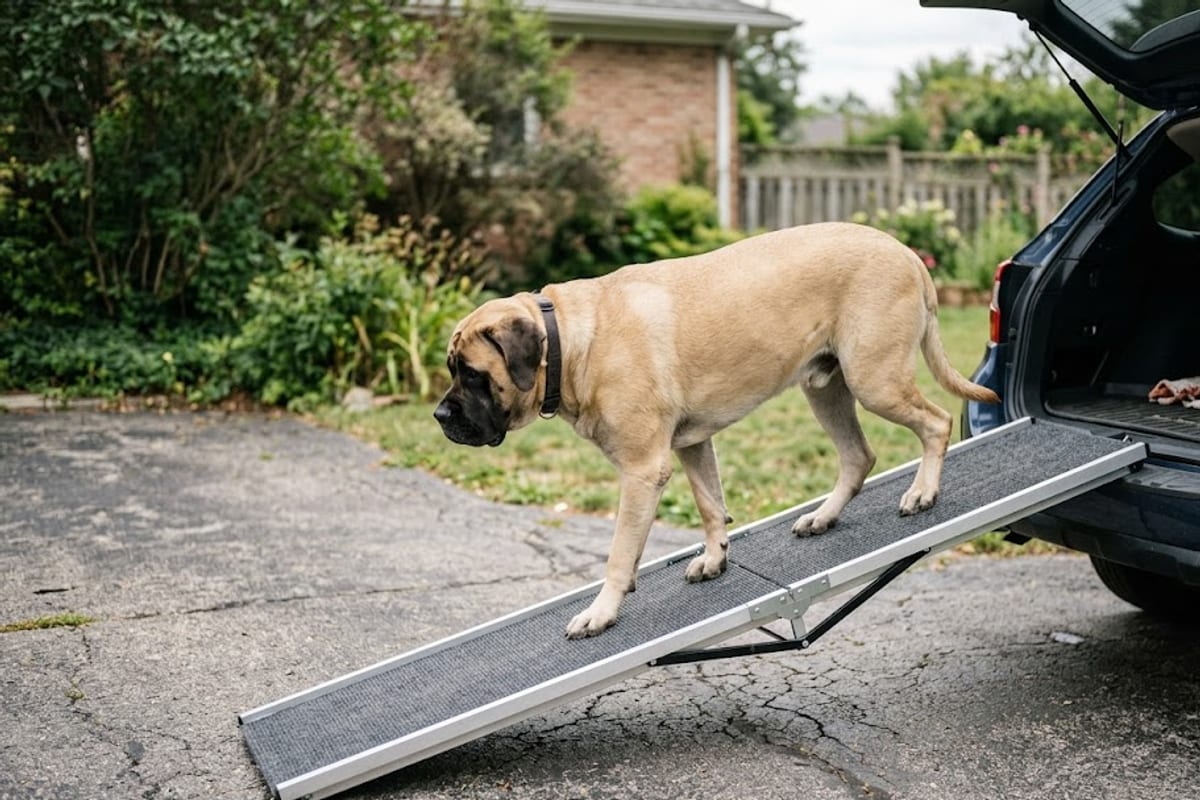
Everyday choices help a Mastiff's joints. Use a ramp for getting into the car rather than asking a 180-pound dog to jump. Choose non-slip flooring where you can. Keep walks moderate and regular rather than occasional and long.
Bloat, or gastric dilatation-volvulus, is a real risk in deep-chested giant breeds. Feeding two or three smaller meals a day rather than one large meal, and avoiding hard exercise right after eating, are common recommendations. Ask your vet about a preventive gastropexy, which is often done at the same time as spaying or neutering.
Mastiff weight and gear
Nothing about a Mastiff fits a standard pet-store size. Collars need to be wide to spread pressure on the neck, harnesses must clear a very deep chest, and crates are usually the largest size made. Starting points are on the Mastiff collar size, harness size and crate size pages. Measure your dog, because a 150-pound female and a 220-pound male need very different gear.
How much food a Mastiff needs
Veterinary calorie estimates start from resting energy requirement: 70 × body weight in kilograms raised to the power 0.75. For a 190-pound (86 kg) male Mastiff, resting energy is about 1,980 kilocalories a day. A neutered adult pet is usually fed around 1.4 to 1.6 times that, roughly 2,750 to 3,150 kilocalories. A 145-pound female works out to about 1,620 at rest and roughly 2,250 to 2,600 for a neutered pet.
Many adult Mastiffs are fairly inactive and need toward the lower end of these ranges, sometimes less. Divide the daily figure by the calories per cup on your dog's food, feed that for three weeks, and adjust by body condition. With a dog this size, a 10% error in portion size is 300 kilocalories a day, enough to add or lose several pounds a month.
Weighing a Mastiff
Most household scales cannot weigh a Mastiff, and lifting one is not an option. Your vet clinic's walk-on scale is the easiest choice, and many clinics are happy for you to drop in between appointments. Some farm supply and feed stores also have platform scales. Weigh every one to two months and record the number. With a dog this size, a 10-pound change can be hard to see but is still more than 5% of body weight.
Frequently asked questions
How much does a full-grown English Mastiff weigh? Males usually weigh 160 to 230 pounds and females 120 to 170 pounds, reaching full weight at around 2½ to 3 years.
Is a 250-pound Mastiff overweight? Most are. A few very tall, heavy-boned males are lean at weights above 230 pounds, but check the ribs and tuck. If you cannot feel the ribs, the dog is carrying extra fat.
How much should a 1-year-old Mastiff weigh? Commonly 130 to 160 pounds for males and 100 to 130 pounds for females, with more than a year of filling out still ahead.
Is an English Mastiff the same as a Bullmastiff? No. The Bullmastiff is a separate, smaller breed, with males at 110 to 130 pounds under the AKC standard.
The general timeline for different sizes of dog is in when do dogs stop growing, and other breeds' adult weights are in the average weight by dog breed chart.