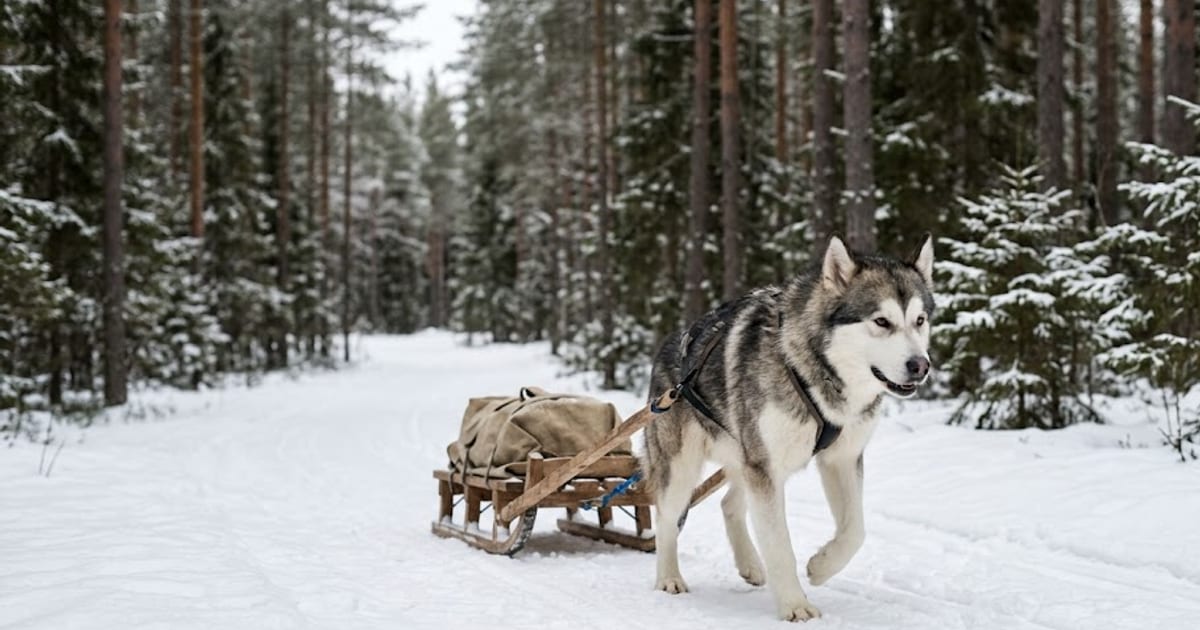
The Alaskan Malamute standard does not give a weight range. It gives a target. According to the AKC breed standard, "the desirable freighting sizes are males, 25 inches at the shoulders, 85 pounds; females, 23 inches at the shoulders, 75 pounds." The standard adds that there is a natural range in size and that size should not outweigh type, proportion and movement.
In practice, healthy adult males mostly weigh 80 to 95 pounds and females 70 to 85 pounds, with the standard's figures near the middle.
The standard at a glance
| Male | Female | |
|---|---|---|
| Desirable weight (AKC standard) | 85 lb | 75 lb |
| Desirable height at the shoulder | 25 in | 23 in |
| Growth complete | about 18–24 months | about 18–24 months |
| Life expectancy (AKC) | 10–14 years | 10–14 years |
Why the standard talks about "freighting size"
The Malamute is a freight dog. It was developed by the Mahlemiut people of northwestern Alaska to haul heavy loads over long distances, not to race. The standard's wording keeps that purpose in view: the ideal Malamute is the size that pulls weight efficiently for hours.
That has a practical consequence for owners. A bigger Malamute is not a better one. Beyond the freighting size, extra body mass costs more energy to move, puts more load on hips and elbows, and adds heat stress in a breed built for cold.
"Giant" Malamutes
Some breeders advertise "giant" Alaskan Malamutes at 120 to 150 pounds or more. These dogs are outside what the breed standard describes. Size of that kind usually comes from selecting for mass over several generations, and a heavy dog is not necessarily a tall one. Many of the largest Malamutes you see are simply carrying fat under a coat that hides it well.
If you are looking at a puppy from a breeder who promotes size above all, ask for hip and elbow screening results on both parents. The Orthopedic Foundation for Animals publishes breed statistics and individual results, and the Alaskan Malamute Club of America recommends hip screening for breeding stock.
Malamute or Husky?
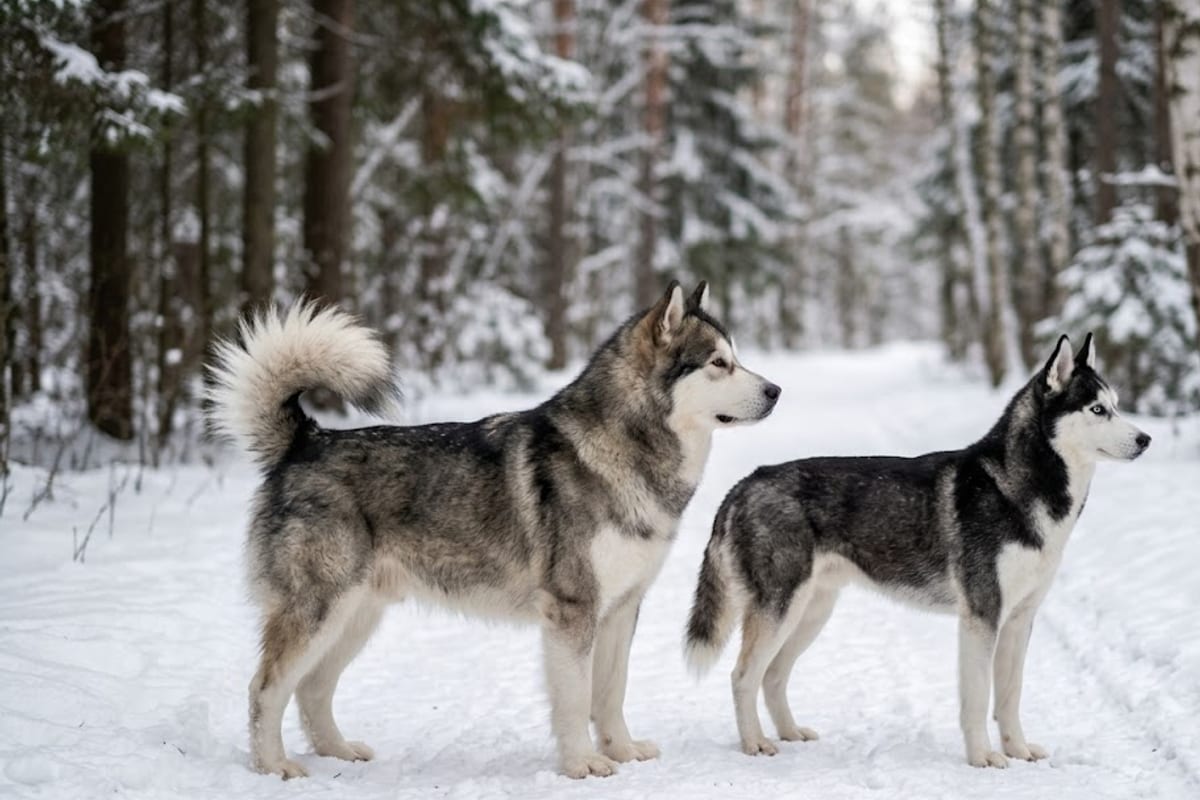
The two breeds are often confused, and their weights are quite different.
| Alaskan Malamute | Siberian Husky | |
|---|---|---|
| Male weight (AKC) | 85 lb | 45–60 lb |
| Female weight (AKC) | 75 lb | 35–50 lb |
| Male height | 25 in | 21–23.5 in |
| Built for | hauling freight | speed over distance |
A "Malamute" at 55 pounds is almost certainly a Husky, a mix, or a very underweight Malamute. The Malamute is broader in the head, heavier in bone and carries its plumed tail over the back.
Judging a Malamute's weight under the coat
The Malamute's double coat is dense enough that looking at the dog tells you very little. A Malamute in full winter coat can look round when it is lean, and an overweight one can look impressive.
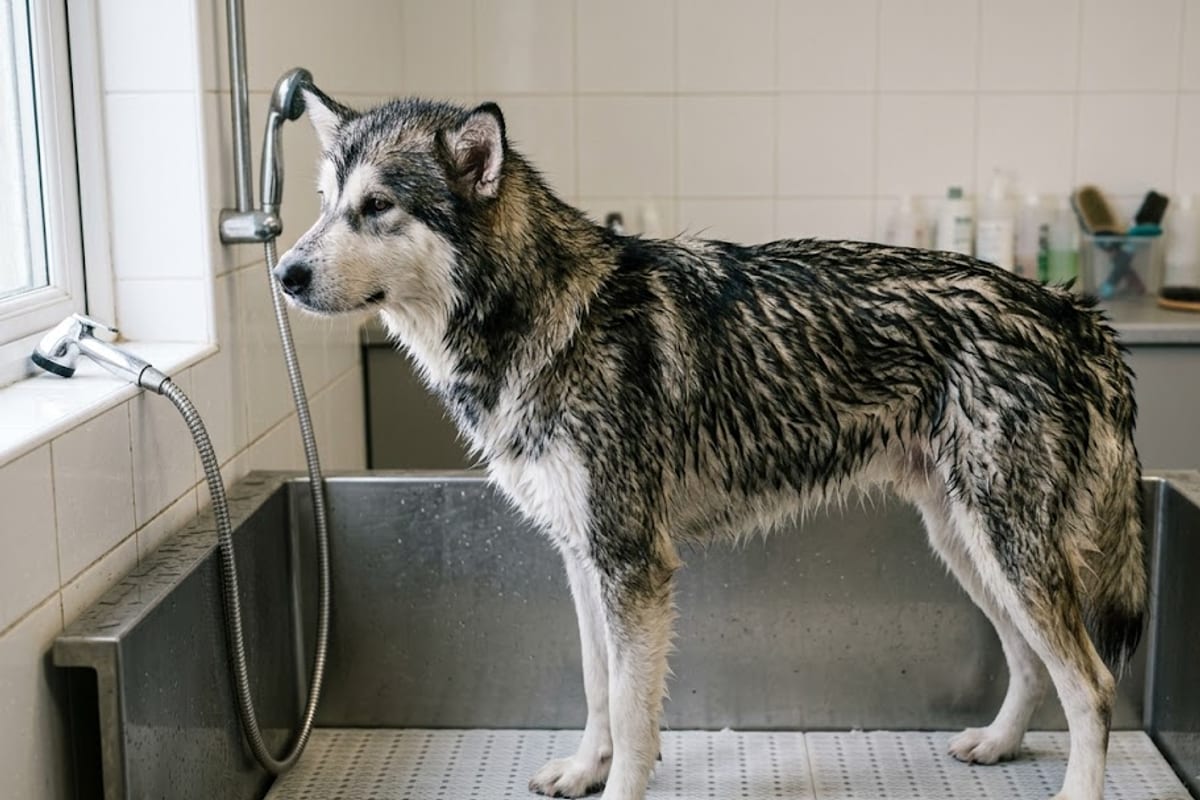
The most honest view of a Malamute's shape is after a bath, when the coat is flattened. Between baths, use your hands.
Ribs. Push your fingers through the coat until you reach skin, then run them along the ribs. You should feel each rib with light pressure and a thin covering of fat.
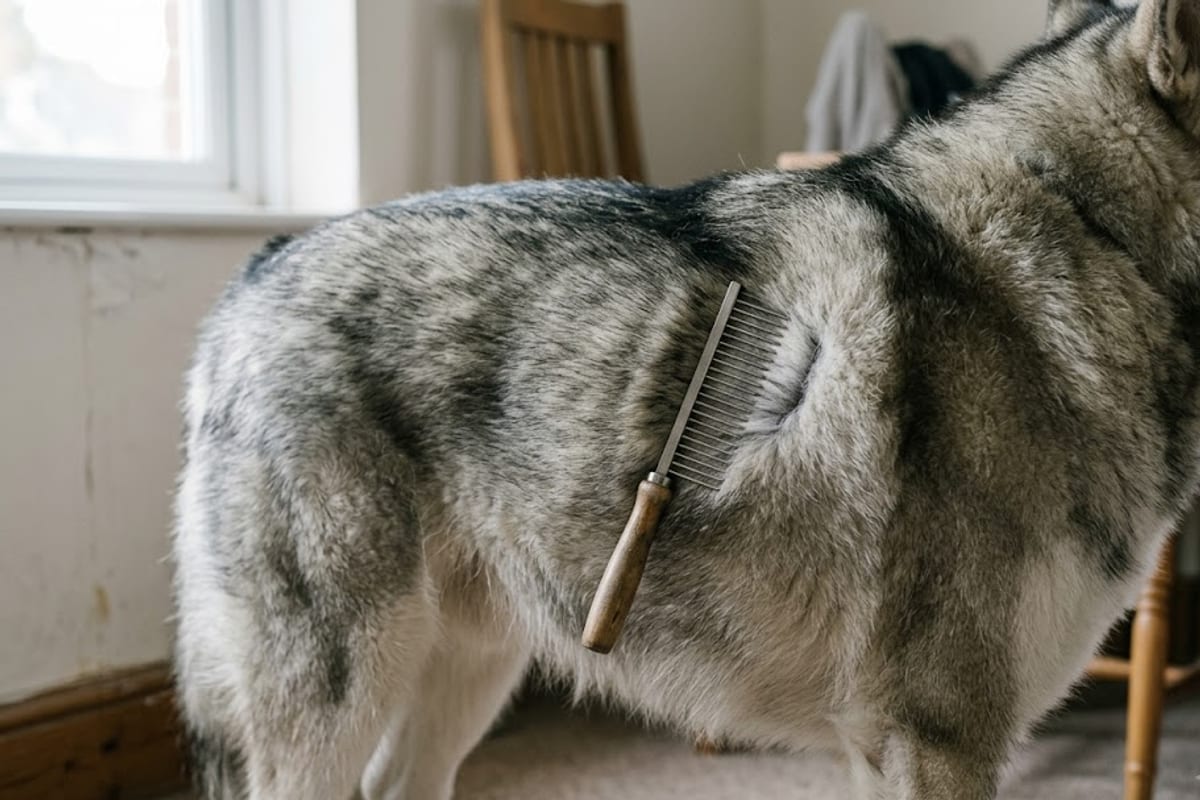
Waist. Put a hand on each side of the dog just behind the ribs. You should feel the body narrow before the hips.
Spine and hips. Along the back you should feel the vertebrae as small bumps under a layer of muscle. If the back feels flat and soft, there is fat over it. If the hip bones are sharp, the dog is thin.
Vets record this as a body condition score. The WSAVA Global Nutrition Guidelines use a 9-point scale, with 4 and 5 as ideal. Each point above 5 adds roughly 10% to body weight, so an 85-pound male at score 7 is likely to weigh around 100 pounds.
Seasonal changes
Malamutes blow their undercoat once or twice a year, and during the shed a dog can look noticeably thinner without having lost any weight. Some Malamutes also eat less in summer heat. Weigh your dog every month or two rather than judging by appearance, and keep a note of the figure so you can see a trend.
How Malamute puppies grow
Malamutes are a slow-maturing large breed. Most reach adult height around 12 to 15 months but keep filling out through the chest, neck and head until 18 to 24 months. Males often look gangly at a year old.
Fast growth is a risk in large-breed puppies. Feed a large-breed puppy food, keep the puppy lean rather than round, and avoid long forced runs on hard surfaces until the growth plates close. The Alaskan Malamute puppy weight chart at 6 months shows typical weights by age and how much of adult weight has been reached.
Calories and work
A Malamute's food needs vary more than most breeds' because working and pet Malamutes live very different lives. A dog pulling sleds or carts in winter can need twice the calories of a pet that walks twice a day. The practical rule for pet Malamutes is to feed to body condition, not to the number on the bag, and to cut back as soon as the ribs become hard to find.
Malamutes are also known for eating like their ancestors, quickly and a lot. Slow-feeder bowls and scatter feeding help with the speed. The quantity is up to the person holding the scoop.
Weight and gear sizing
A Malamute's chest girth and neck measurement matter more for gear than its weight. Pulling harnesses in particular must fit closely at the chest and clear the shoulders. Starting sizes are on the Alaskan Malamute harness size, collar size and crate size pages. Measure against the skin, then decide separately how much room to allow for the coat.
How much food a Malamute needs
Veterinary nutritionists start from resting energy requirement, calculated as 70 × body weight in kilograms raised to the power 0.75, and then multiply by a factor for life stage and activity. For an 85-pound (38.6 kg) male, resting energy is about 1,080 kilocalories a day. A neutered adult pet is usually fed around 1.4 to 1.6 times that, roughly 1,500 to 1,750 kilocalories. An intact, active dog may need 1,950 or more, and a Malamute hauling a sled in cold weather can need several times its resting energy.
For a 75-pound female, the same calculation gives about 990 kilocalories at rest and roughly 1,400 to 1,600 for a neutered pet.
These figures are starting points. Divide them by the calories per cup printed on your dog's food to get a daily amount, feed that for three weeks, then adjust by body condition. Most owners find that a Malamute kept as a house pet needs less than the feeding guide on the bag suggests.
Signs a Malamute is too thin
Underweight Malamutes are less common than overweight ones, but the coat hides both. A dog is likely too thin if:
- the spine and hip bones feel sharp under your hand,
- the ribs can be felt individually with no fat covering at all,
- the muscles over the head and shoulders feel reduced,
- or the dog has lost weight you did not plan.
Young, very active males sometimes run lean, especially in their second year. Unplanned weight loss in an adult should be checked by a vet.
Frequently asked questions
How much does a full-grown Alaskan Malamute weigh? The standard's desirable weights are 85 pounds for males and 75 pounds for females. Most healthy adults fall within about 10 pounds of those figures.
Are Malamutes supposed to weigh over 100 pounds? Not according to the breed standard. A tall, heavy-boned male can be lean at 95 pounds, but most Malamutes over 100 pounds are carrying extra fat.
Why does my Malamute look so big? Mostly coat. The dense double coat can add several inches of apparent width. Feel for the ribs and waist to judge the body underneath.
When does a Malamute stop growing? Height usually finishes between 12 and 15 months. Weight and muscle continue to develop until about 2 years. The general pattern is covered in when do dogs stop growing.
Other breeds' adult weights are listed side by side in the average weight by dog breed chart.