
An adult male Golden Retriever should weigh 65 to 75 pounds and an adult female 55 to 65 pounds. Those figures come straight from the AKC breed standard, which is unusual: most breed standards give a height and leave weight to judgement. The Golden standard gives both, with males 23 to 24 inches at the shoulder and females 21½ to 22½ inches.
Adult weight at a glance
| Male | Female | |
|---|---|---|
| Weight (AKC standard) | 65–75 lb | 55–65 lb |
| Height at the withers | 23–24 in | 21.5–22.5 in |
| Typical age at adult height | 12–15 months | 12–15 months |
| Typical age at adult weight | about 18 months | about 18 months |
A Golden that sits a few pounds outside its range is not automatically overweight or underweight. The standard describes the dog breeders aim for in the show ring. What matters for an individual dog is body condition, covered further down.
Why so many Goldens weigh more than the standard
If you meet a lot of Golden Retrievers, 80 and 90 pound dogs will not seem unusual. There are two reasons.
The first is simple weight gain. Golden Retrievers are one of the breeds most prone to becoming overweight. A 2021 study of 22,333 dogs in UK veterinary practices, published by the Royal Veterinary College's VetCompass programme, found Golden Retrievers had 2.58 times the odds of being recorded as overweight compared with crossbred dogs. Only Pugs and Beagles ranked higher.
The second is that the breed has split into lines that look quite different.

Field-line Goldens are bred for retrieving and hunt tests. They tend to be darker red, lighter boned and leaner, and a healthy field-line female can weigh 50 to 55 pounds.
Show-line Goldens are bred toward the conformation ring. They carry more bone and coat, with broader heads and deeper chests. A fit show-line male can reach the top of the range or slightly beyond it without carrying any excess fat.
So a 58-pound field-line female and a 76-pound show-line male can both be in excellent condition. Comparing either one to the midpoint of a breed chart tells you very little.
Checking body condition
Veterinarians judge weight with a body condition score. The most common version, used in the WSAVA Global Nutrition Guidelines, runs from 1 (emaciated) to 9 (severely obese), with 4 and 5 as ideal. Each point above 5 represents roughly 10% extra body weight.
You can do a reasonable version at home in under a minute.
Ribs. Run your flat palms along the sides of the chest. At an ideal weight you can feel each rib under a thin layer of fat without pressing. If you have to push to find them, the dog is carrying extra weight. If you can see them from across the room on a short-coated area, the dog is thin.
Waist from above. Stand over the dog and look down. There should be a visible narrowing behind the ribcage before the hips.
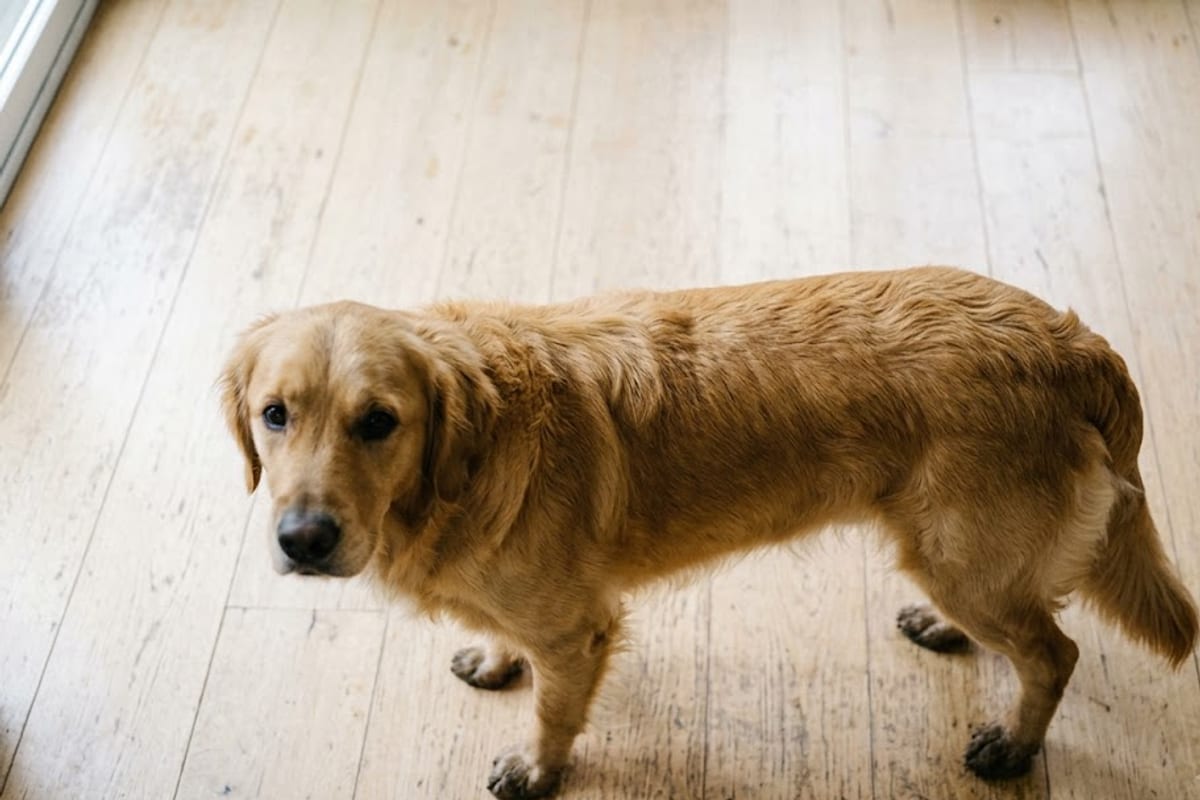
Tuck from the side. The belly line should rise from the bottom of the chest toward the back legs. A straight or sagging line from chest to hind legs usually means excess fat.
The Golden coat makes the visual checks harder. A full coat can hide 5 to 10 pounds of extra weight, which is why the rib check with your hands matters more than looking.
How weight affects a Golden's joints and lifespan
Extra weight matters more in Golden Retrievers than in many breeds because the breed has a high rate of hip and elbow dysplasia, and every extra pound loads those joints.
The strongest evidence for keeping a retriever lean comes from a 14-year study of 48 Labrador Retrievers, a closely related breed, published in the Journal of the American Veterinary Medical Association in 2002 by Kealy and colleagues. Littermates were paired and one of each pair was fed 25% less than the other. The leaner dogs had a median lifespan of 13 years against 11.2 years for their littermates, and signs of osteoarthritis appeared later.
The difference between the two groups was not dramatic in body shape. The heavier dogs were mostly what an owner would call "a bit solid". That is the practical point: a Golden that looks normal to most people can still be carrying enough weight to shorten its life.
How fast Golden puppies reach adult weight
Golden Retrievers are a large breed and grow for longer than small dogs. Most reach their adult height between 12 and 15 months and then continue to fill out through the chest and shoulders until around 18 months, sometimes later in males.
A puppy that looks lanky at a year old is normal. For month-by-month expected weights, the Golden Retriever puppy weight chart at 6 months shows where a typical puppy should be and what share of adult weight it has reached.
Two points are worth knowing for puppies:
- Weight gain should be steady, not fast. Large-breed puppies that grow too quickly are at higher risk of developmental joint problems. This is why large-breed puppy foods have controlled calcium and energy levels.
- Neutering age affects adult size. Dogs neutered before their growth plates close tend to grow slightly taller, and neutered dogs of both sexes need fewer calories to hold the same weight.
If your Golden is outside the range
Heavier than 75 lb (male) or 65 lb (female). Do the rib and waist checks first. A big-boned show-line dog may be fine. If you cannot feel the ribs easily, reduce daily food by about 10%, stop counting training treats as free, and weigh the dog again in three weeks. A safe rate of loss is about 1 to 2% of body weight per week.
Lighter than 55 lb (female) or 65 lb (male). Many field-line dogs are lighter and perfectly healthy. Ribs that are easily visible, prominent hip bones, or weight loss you did not plan are reasons to see a veterinarian.
Getting heavier with age. Older Goldens often need fewer calories as activity drops. A dog that has gained 5 pounds between the ages of 6 and 9 on the same food is usually eating more than it now uses.
Weight and gear sizing
Weight is a poor guide to gear fit, because two dogs of the same weight can have very different chest and neck measurements. For a Golden, the numbers that decide sizing are chest girth for a harness and neck circumference for a collar. Breed-level starting points are on the Golden Retriever harness size, collar size and crate size pages. If your dog has changed weight noticeably, measure again rather than relying on the size you bought last year.
Frequently asked questions
How much should a 1-year-old Golden Retriever weigh? Most 1-year-old males weigh 55 to 70 pounds and females 45 to 60 pounds, with several months of filling out still to come.
Is 80 pounds too heavy for a Golden Retriever? For most females, yes. For a male it depends on bone and line. Check the ribs and waist. If both are easy to find, a large show-line male at 80 pounds can be lean.
Do male and female Golden Retrievers differ much in weight? The standard puts the difference at about 10 pounds, and in practice it is often 10 to 15 pounds.
When does a Golden Retriever stop gaining weight? Height usually finishes between 12 and 15 months, and most dogs reach adult weight around 18 months. The general pattern across breeds is explained in when do dogs stop growing.
For other breeds, the average weight by dog breed chart lists adult ranges side by side.