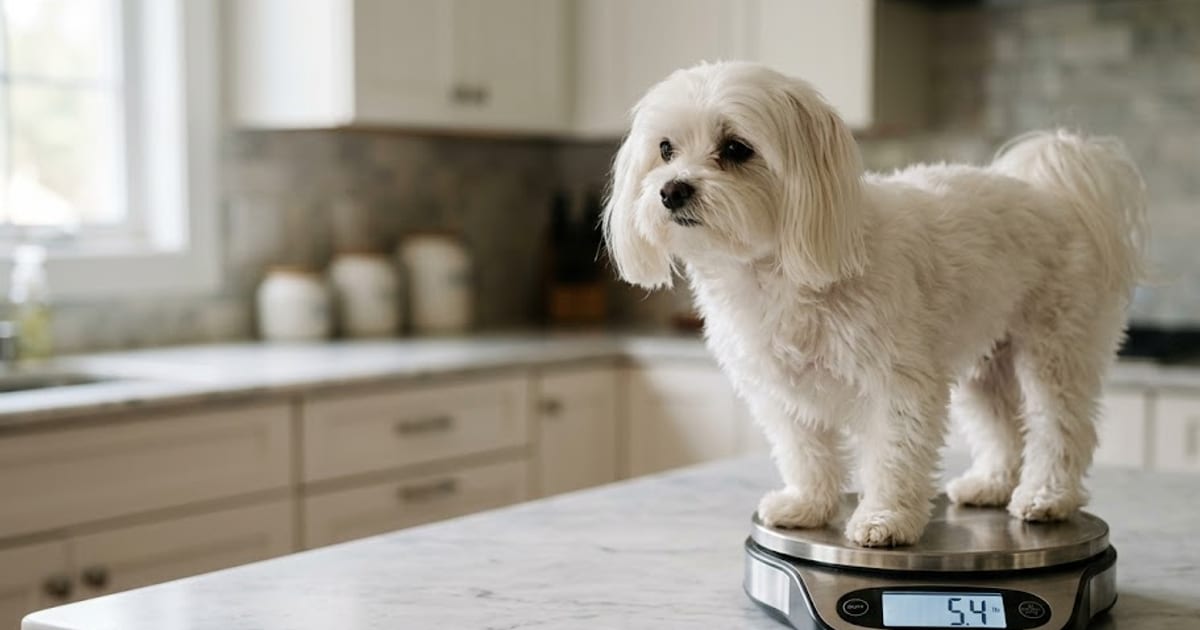
The Maltese breed standard gives a weight, not a height. According to the AKC standard, adults should weigh under 7 pounds, with 4 to 6 pounds preferred, and "overall quality is to be favored over size." The AKC's Maltese page lists a height of 7 to 9 inches.
Maltese size at a glance
| Male and female | |
|---|---|
| Weight (AKC standard) | under 7 lb, 4–6 lb preferred |
| Height (AKC guide) | 7–9 in |
| Adult size reached | about 10–12 months |
| Life expectancy (AKC) | 12–15 years |
Why so many pet Maltese weigh more than 7 pounds
It is common to meet Maltese that weigh 8, 9 or 10 pounds. There are three usual explanations.
Size variation from pet breeding. The standard describes the dog shown in the conformation ring. Maltese from pet lines are often a little larger boned and taller than show dogs. A 9-inch Maltese with sturdy bone can be lean at 8 pounds.
Mixed ancestry. Maltese crosses are popular, and a dog sold as a Maltese can carry Shih Tzu, Poodle or Bichon in its background. These breeds are all heavier.
Extra weight. Some are simply overweight. In a dog this small, one pound is a large share of the body, so it takes very little overfeeding.
The standard's preference for 4 to 6 pounds is not a health requirement. A 7½-pound Maltese in good condition is not a problem. A 7½-pound Maltese that should be 5½ pounds is carrying almost 40% extra weight.
The coat hides everything
A Maltese in a full coat is a curtain of white silk from back to floor, and you cannot see the body at all. In a short puppy cut the same dog can look half the size.

To check body condition, use your hands:
Ribs. Slide your fingertips under the coat along the chest. The ribs should be easy to feel with light pressure. On a Maltese they are small and close together, so feel carefully.
Waist. Circle the body just behind the ribs with your thumb and fingers. You should feel it narrow before the hips.
Spine and hips. The backbone should be easy to trace but not sharp. Sharp hip bones and a spine you can see through a short coat mean the dog is thin.
On the 9-point body condition score in the WSAVA Global Nutrition Guidelines, 4 and 5 are ideal and each point above 5 is about 10% extra weight. For a 5-pound Maltese, one point is about half a pound.
Weighing a very small dog accurately
Bathroom scales are not accurate enough for a 5-pound dog, and weighing yourself with and without the dog adds the error of two readings together. Better options:
- A digital kitchen or baby scale with a flat platform. Many read to a tenth of a pound or better.
- The scale at your vet clinic, which most practices let you use between appointments.
- A basket or box on a kitchen scale. Weigh the empty basket first, then with the dog in it, and subtract.
Weigh at the same time of day, before a meal, once a month. Keep a note of the readings. A change of half a pound in a month is worth noticing.
How small is a 5-pound dog?
People who have not lived with a toy breed often underestimate how little room there is for extra food.

A healthy 5-pound Maltese is about the size of a small house cat. Using the standard veterinary energy formula (resting energy of 70 × body weight in kilograms to the power 0.75, multiplied by an activity factor), it needs roughly 180 to 250 kilocalories a day. A single medium dog biscuit can be 30 to 40 kilocalories, and a slice of cheese 60 to 110. A few extras can easily add a quarter to a half of the day's needs.
Maltese puppies
Maltese grow quickly and reach adult size by about 10 to 12 months. Tiny puppies need careful feeding: toy-breed puppies have small energy reserves and can develop low blood sugar (hypoglycemia) if they go too long without food, especially in the first few months. Feed several small meals a day and follow your breeder's and vet's guidance.
The Maltese puppy weight chart at 6 months shows expected weight by age. A puppy tracking well below the chart may simply be a small Maltese, but a puppy that stops gaining should be checked.
When low weight is the concern
With a breed this small, weight loss is easy to miss and matters more. A drop from 6 pounds to 5 pounds is a loss of about 17% of body weight.

Common reasons a Maltese loses weight slowly:
- Dental disease. Toy breeds have crowded mouths and are prone to tartar, gum disease and tooth loss. A sore mouth leads to eating less, often without obvious signs.
- Picky eating. Some Maltese learn that refusing food brings better food. That tends to lead to weight swings rather than steady loss.
- Illness. Any unexplained loss, vomiting, diarrhea or lethargy is a reason for a vet visit.
"Teacup" Maltese
There is no teacup variety of Maltese. Dogs advertised as teacup are usually bred to be under 4 pounds, below the size the standard prefers. Very small dogs are more prone to hypoglycemia, fractures and other problems, and they are not better examples of the breed.
Weight and gear
Very small dogs are easy to injure with the wrong collar. Many Maltese owners use a lightweight harness for walks to keep pressure off the neck and trachea. Starting sizes are on the Maltese harness size and collar size pages, and Maltese crate size covers crates and carriers.
Senior Maltese
Maltese often live into their mid-teens. In old age, a small drop in weight can be the first sign of dental disease, kidney disease or other problems. For a 5-pound dog, losing half a pound is a 10% change. Weigh a senior Maltese monthly on an accurate scale, keep the numbers, and take any steady downward trend to your vet. Softer food or smaller kibble can help an older Maltese with dental problems eat enough while the underlying cause is treated.
Helping a Maltese lose weight
The principles are the same as for any dog, but the amounts are tiny. A safe rate of weight loss is about 1 to 2% of body weight per week. For a 7-pound Maltese aiming for 5½ pounds, that is roughly 1 to 2 ounces a week, and the whole process can take three to four months. Cut daily food by about 10%, replace commercial treats with a few pieces of the dog's own kibble, and weigh every two weeks on an accurate scale.
Frequently asked questions
How much should a full-grown Maltese weigh? Under 7 pounds under the breed standard, ideally 4 to 6 pounds. Healthy pet Maltese sometimes weigh a little more.
Is 10 pounds too heavy for a Maltese? For most purebred Maltese, yes. Check the ribs and waist. A large-boned dog or a Maltese mix may carry 10 pounds without excess fat, but that is uncommon.
When does a Maltese stop growing? Most reach adult size at 10 to 12 months. The general pattern across breeds is in when do dogs stop growing.
Do male and female Maltese differ in size? Only slightly. The standard uses the same weight for both.
Adult weights for other breeds are listed in the average weight by dog breed chart.