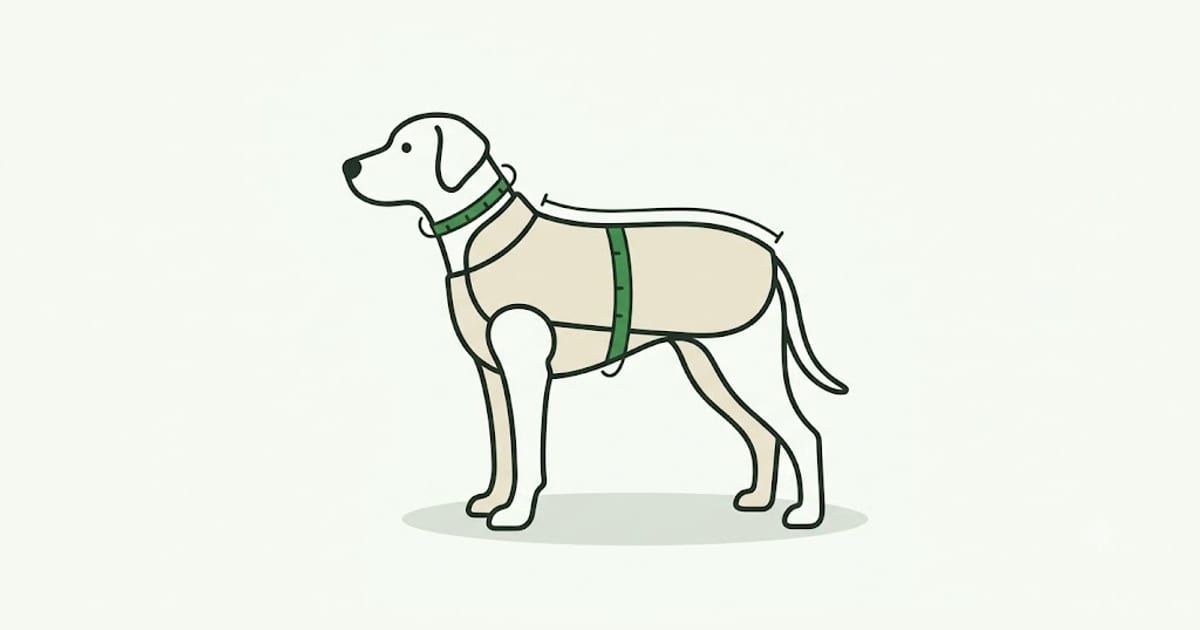
Dog coats are sold by weight and worn along the back, and those two things are only loosely related. A 25-pound Dachshund and a 25-pound Jack Russell need entirely different coats, and the weight-based chart cannot tell them apart.
The measurement that decides it
Back length: base of the neck to the base of the tail, measured along the spine with the dog standing normally.
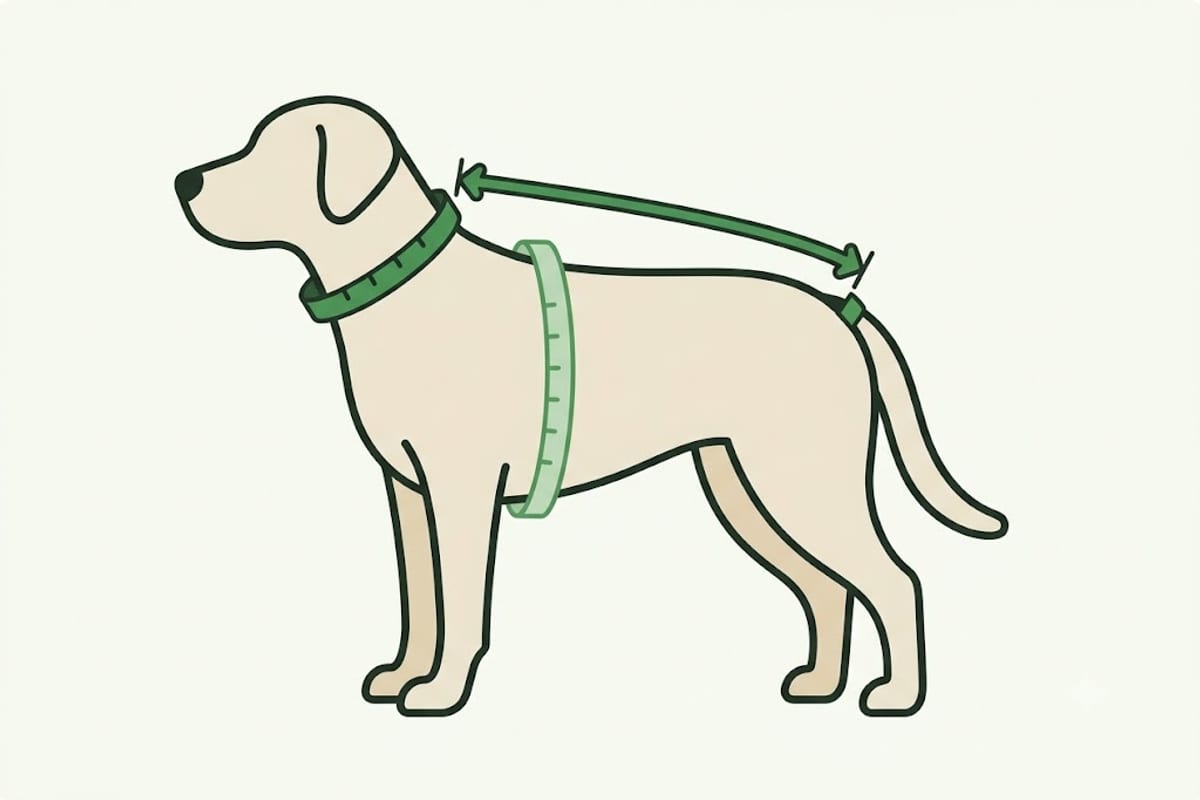
That is the number. A coat that is right on back length and slightly off on girth is wearable; a coat that is right on girth and wrong on back length is not.
Too long and it covers the tail base and interferes with toileting — the single most common complaint about dog coats, and it is a sizing error rather than a design flaw. Too short and the back end is uncovered, which defeats the point.
Chest girth, measured around the deepest part just behind the front legs, is the second number. It determines whether the coat closes.
The breeds the chart gets wrong
Weight-indexed sizing fails predictably on particular shapes:
- Dachshunds and Corgis — long backs on short legs. Almost always need a longer coat than their weight suggests, and often a much shorter leg opening.
- French Bulldogs and Pugs — barrel chests. Girth is far larger relative to weight than the chart assumes, so the coat fits along the back and will not fasten.
- Greyhounds and Whippets — long backs, deep narrow chests, very little body fat. Sized by weight they get something far too small.
- Double-coated breeds — Samoyeds, Huskies, Shetland Sheepdogs. Measure under the coat, and question whether they need one at all.
Which dogs actually need a coat
Not most of them, and it is worth saying plainly on a page selling the idea of sizing one.
Genuinely benefit: thin-coated breeds (Greyhounds, Whippets, Boxers, Dobermans), very small dogs with a high surface-area-to-volume ratio, elderly and arthritic dogs, and dogs recovering from illness or clipping.
Generally do not: double-coated northern breeds. A Husky's coat is a better insulator than anything you can buy, and covering it can interfere with how it works. A Samoyed in a coat is usually a person's preference rather than a dog's need.
Boots, and the measurement people get wrong
Boots are sized by paw width, and the measurement must be taken with the dog's weight on the paw. A paw spreads under load — sometimes considerably — and a boot measured on a lifted foot is a boot that will not go on, or will come off in use.
The practical method: stand the dog on a sheet of paper, mark either side of the widest part of the paw with the foot loaded, and measure between the marks.
Front and back paws are frequently different sizes, front usually larger. Measure both.
Fit matters more here than anywhere else in dog apparel, because a loose boot is lost within a walk and a tight one is refused outright.
When boots earn their place
Ice-melting salt is the strongest reason — it irritates and cracks pads, and dogs then lick it off. Hot pavement is the other: surface temperature runs far above air temperature in summer, and the back of a hand held to the ground for a few seconds settles the question.
Rough terrain and snow packing between the toes account for most of the rest.
Sizing for everything else on the dog is covered in harness sizing and collar sizing.
FAQ
How do I measure my dog for a coat?
Back length along the spine from the base of the neck to the base of the tail, plus chest girth behind the front legs. Back length is the number that decides the size.
Why doesn't my dog's coat fit if the weight is right?
Because coats fit along the back and are sold by weight. Long-backed breeds and barrel-chested breeds are the ones this fails on most often.
Do dogs actually need coats?
Thin-coated, very small, elderly or recovering dogs benefit. Double-coated northern breeds generally do not — their own coat insulates better than anything you can buy.
How do I measure paws for dog boots?
Stand the dog on paper with weight on the paw, mark either side of the widest point, and measure between the marks. A paw spreads under load, and measuring a lifted foot gives a boot that will not fit.
Are front and back paws the same size?
Often not — front paws are usually larger. Measure both.