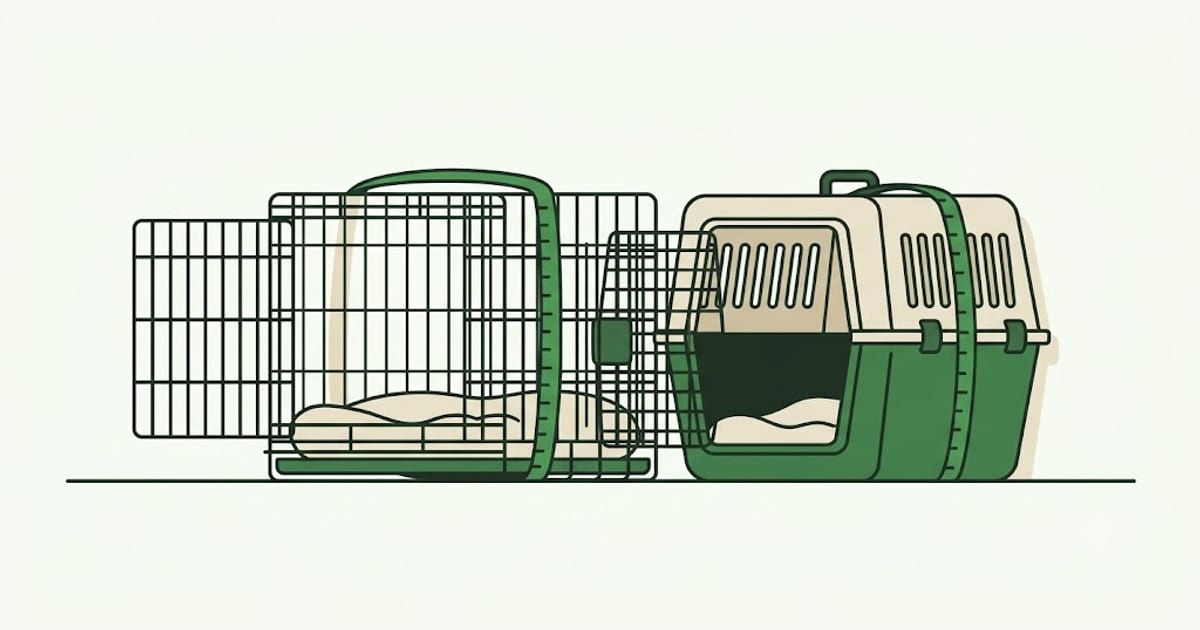
| Wire | Plastic | Soft-sided | |
|---|---|---|---|
| Ventilation | excellent | limited | good |
| Enclosed feel | open | den-like | semi |
| Folds flat | yes | no | yes |
| Divider available | usually | rarely | rarely |
| Security | good | good | poor |
| Weight | heavy | moderate | light |
| Cleaning | easy | easy | difficult |
Wire
The default for home use, and the reason most sizing charts are written around wire crate dimensions.
Ventilation and visibility. The dog sees the room and air moves freely — important in warm weather.
Takes a divider, which is what makes one crate work from puppy to adult. That alone often decides it. See what size crate for a puppy.
Folds flat for storage and transport.
The open sides suit some dogs and unsettle others. A cover over three sides gives the enclosed feeling without losing the divider or the folding — worth trying before concluding a dog dislikes crates.
Plastic
Enclosed on all sides with a barred door.
Den-like, which genuinely helps anxious dogs. A dog that paces in a wire crate often settles in a plastic one.
Warmer and darker, useful in winter and for dogs disturbed by movement in the room. The same properties are a liability in summer heat, since ventilation is limited to the door and side vents.
Travel. Plastic crates are what airlines generally accept, though specific requirements vary by carrier and change — check with the airline rather than assuming, and check well before the flight.
Does not fold, so it takes permanent space.
Soft-sided
Fabric over a frame. Light, packs down, easy to carry.
Only suitable for dogs already reliably settled in a crate. A dog that wants out of a soft crate gets out — through the zip, through the mesh, or by moving the whole thing.
Also hard to clean properly, which matters for a puppy.
Good for travel, shows and holidays with a dog that already crate-trains well. Not for house-training, and not for anxious or destructive dogs.
Escape-prone dogs
Some breeds treat a latch as a problem to solve. Beagles and Jack Russell Terriers are the usual examples.
A standard single wire-clip door is not much of an obstacle to either. A second latch or a carabiner through the door frame costs almost nothing and solves it — considerably cheaper than a heavy-duty crate.
For genuinely determined escapers, welded steel crates exist, though a dog trying that hard to escape usually has a distress problem the crate will not fix.
Where to put it
Somewhere the household actually is. A crate in a spare room teaches the dog that going in means being left alone, which is the opposite of the intended association.
A living room corner out of the traffic path works better, and it makes a wire crate's openness an advantage rather than a drawback.
FAQ
Is a wire or plastic crate better?
Wire for home use — better ventilation and it takes a divider. Plastic for anxious dogs and for travel, since it feels enclosed.
Do soft crates work?
Only for dogs already settled in a crate. They are not secure enough for house-training or for a dog that objects to being confined.
Which crate is allowed on a plane?
Generally a hard plastic travel crate, but requirements vary by airline and change. Check with the carrier well in advance.
My dog seems unsettled in a wire crate. What can I do?
Cover three sides. It gives the enclosed feel of a plastic crate while keeping the divider and the ability to fold.
How do I stop my dog opening the crate?
A second latch or a carabiner through the door frame. Beagles and Jack Russells in particular defeat single wire clips.