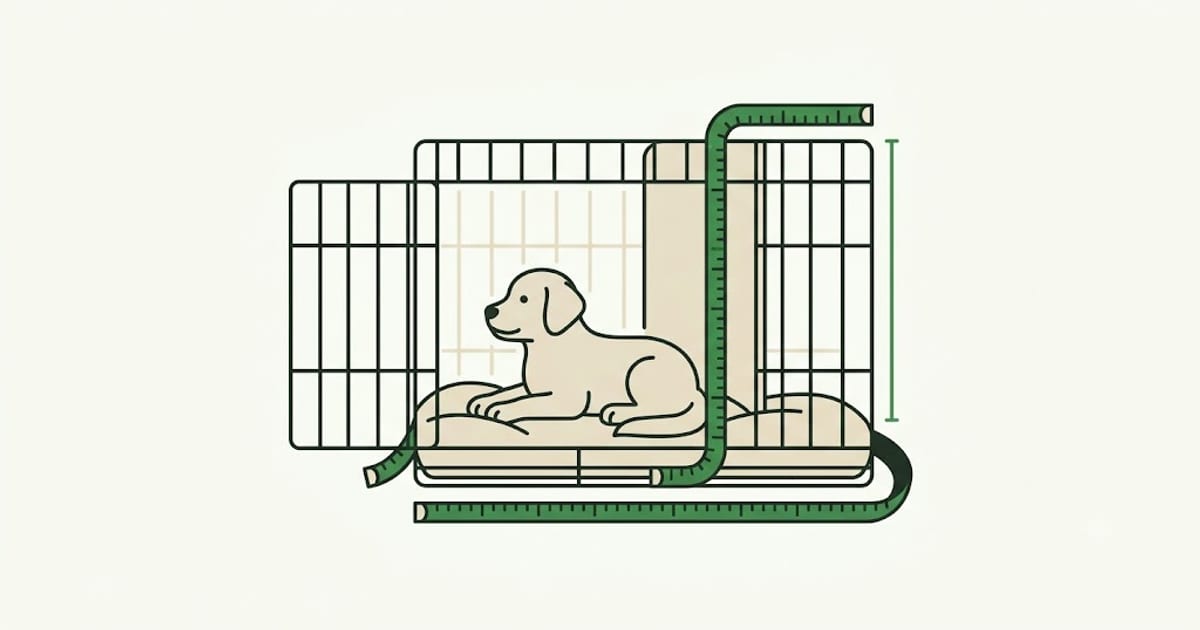
Buy the crate the adult dog will need, and use the divider panel to shrink the usable space while the puppy grows.
One crate, correct at every stage, and no second purchase.
Why oversized is a problem
House-training relies on a simple instinct: dogs are reluctant to soil where they sleep.
Give a puppy enough room to sleep at one end and toilet at the other, and that instinct stops applying — the puppy is no longer soiling where it sleeps. The crate has quietly stopped being a house-training aid and become a very expensive indoor toilet area.
This is why crate sizing runs opposite to nearly every other sizing question. With a collar or harness, too big is a fit problem. With a crate, too big defeats the purpose.
Using the divider
The usable section should be just large enough for the puppy to:
- stand without ducking,
- turn around comfortably,
- lie down stretched out.
Nothing more. Move the divider back as the puppy grows — every few weeks during fast growth, checking against those three tests each time.
If the puppy is having accidents in a correctly sized section, the problem is the schedule rather than the crate. A puppy can typically hold for roughly its age in months plus one, in hours, and less overnight is normal.
Adult sizes for common breeds
| Crate | Adult breeds |
|---|---|
| 24 in | Chihuahua, Yorkshire Terrier, Pomeranian, Maltese |
| 30 in | Beagle, Cocker Spaniel, French Bulldog, Corgi |
| 36 in | Border Collie, Australian Shepherd, Springer Spaniel |
| 42 in | Labrador, Golden Retriever, German Shepherd, Boxer |
| 48 in | Great Dane, Mastiff, Newfoundland, Saint Bernard |
Measure rather than read the row where you can — the method is in crate sizing. Two body shapes break the breed table reliably: long-backed dogs like Dachshunds and Corgis need length their weight does not predict, and tall lean dogs need height.
For a mixed-breed puppy, ask the rescue or vet for an adult weight estimate. Paw size is folklore, not a predictor.
Where to put it
Somewhere the household actually is. A crate in a spare room teaches a puppy that going in means being left alone, which is the opposite of what a crate is for.
A living room corner, out of the main traffic path, works better — the puppy rests near people and the crate stays associated with ordinary calm rather than isolation.
Bedding, and what to leave out
Soft bedding is fine for most puppies. Some chew and swallow it, and for those the answer is a plain crate mat or nothing until the habit passes — an intestinal blockage is a far worse outcome than a hard floor.
Leave collars off inside the crate. Tags and buckles catch on wire, and it happens unobserved.
FAQ
What size crate should I buy for a puppy?
The adult size for the breed, with a divider to reduce the usable space while the puppy grows.
Why shouldn't a puppy crate be too big?
Extra space lets the puppy sleep at one end and toilet at the other, which undermines house-training.
When should I move the divider?
Every few weeks during fast growth. The puppy should be able to stand without ducking, turn around and lie stretched out — and no more.
What size crate for a Labrador puppy?
A 42-inch crate, which is the adult size, with the divider set forward while the puppy is small.
Should my puppy wear a collar in the crate?
No. Tags and buckles catch on wire crates, and it happens when nobody is watching.