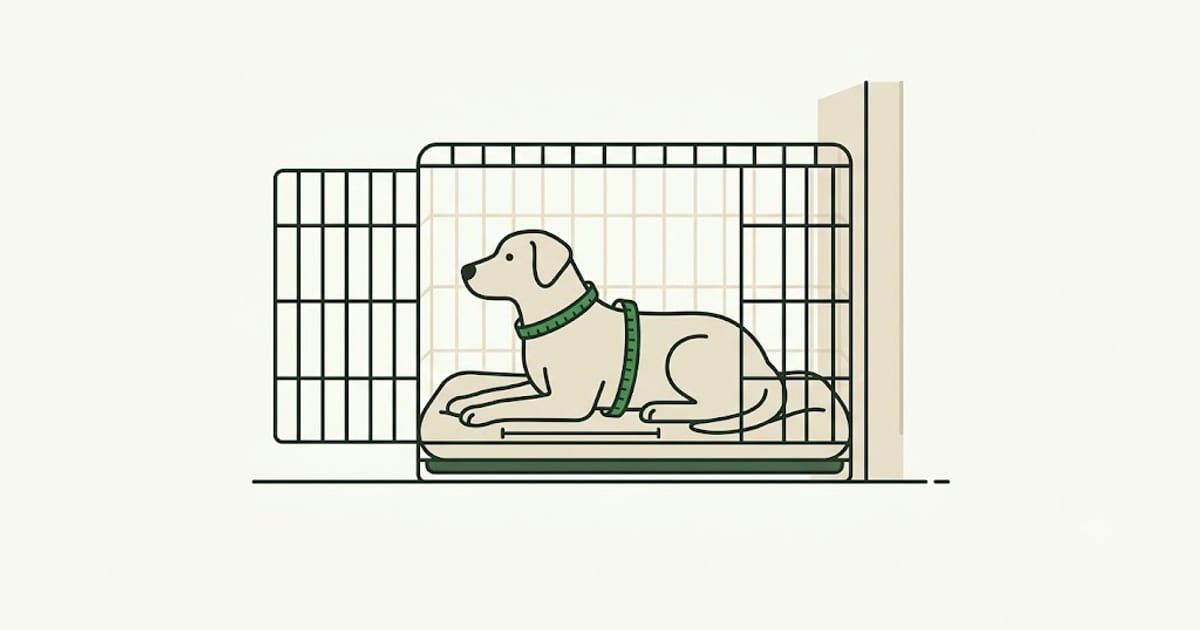
Crate sizing needs two measurements, and neither of them is weight.
- Length: nose to the base of the tail — not the tip. Add 2–4 inches.
- Height: floor to the top of the head while sitting. Add 2–4 inches.
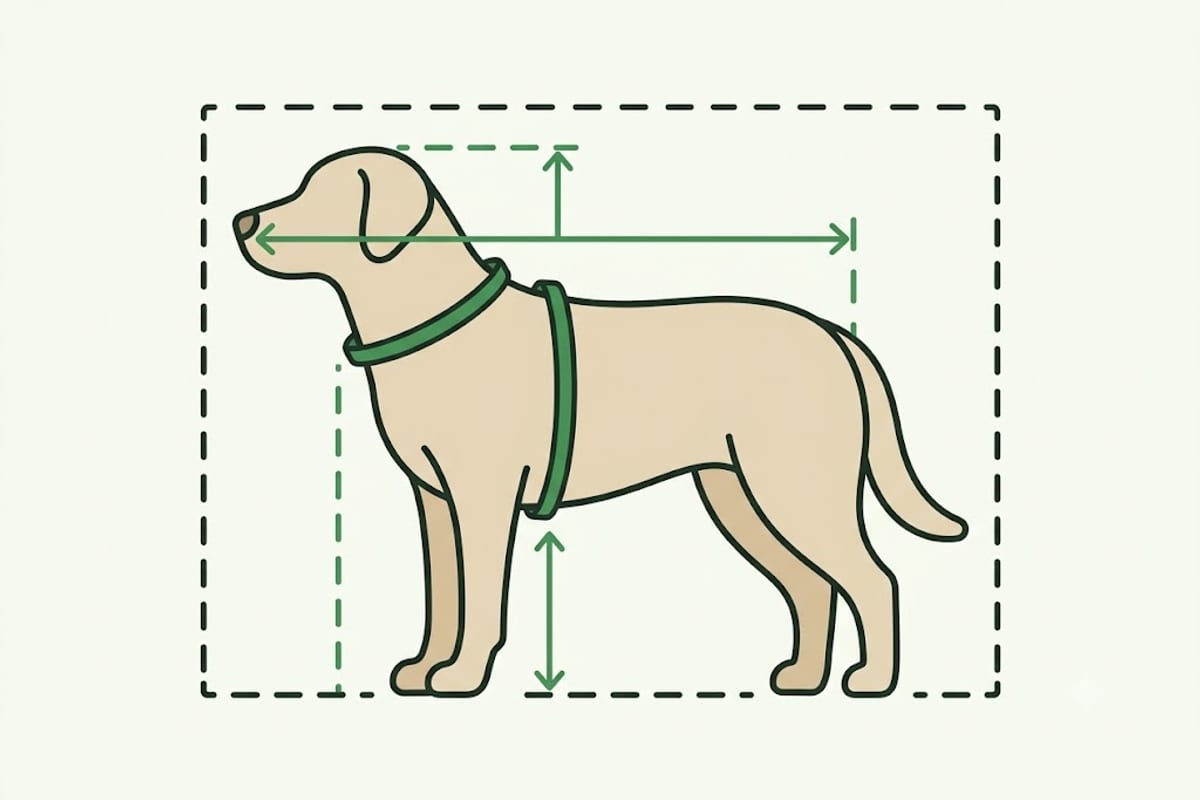
The dog should be able to stand without ducking, turn around, and lie stretched out. That is the whole requirement.
Crates come in six standard lengths, so the measurement rounds up into one of them:
| Crate | Typical dog |
|---|---|
| 18 in | very small toy breeds |
| 24 in | small terriers, toy breeds |
| 30 in | Beagle, Cocker Spaniel, Corgi |
| 36 in | Border Collie, Australian Shepherd |
| 42 in | Labrador, Golden Retriever, German Shepherd |
| 48 in | Great Dane, Mastiff, Newfoundland |
Why too big is a genuine problem
This is where crate sizing differs from every other sizing question on this site. With a collar or a harness, erring large means it fits poorly. With a crate, erring large defeats the purpose.
House-training relies on a dog's reluctance to soil where it sleeps. Give it enough room to use one end as a bed and the other as a toilet and that reluctance stops applying — the dog is no longer soiling where it sleeps.
This is why crates for growing puppies come with a divider. Buy the crate for the adult dog and move the divider forward as the puppy grows, so the usable space stays correct at every stage. One crate, correct throughout.
The breeds where the chart misleads
Two body shapes break the weight-to-crate assumption, and both do it in the same direction.
Long-backed breeds — Dachshunds and Corgis especially — need a crate sized by length, not weight. A 25-pound Corgi is far longer than a 25-pound terrier and needs a longer crate despite the identical number on the scale.
Tall breeds with modest weight, such as a lean sighthound, need height the weight chart does not predict.
Both cases resolve immediately if you measure the dog. This is the same failure the breed chart has everywhere: it is indexing on a number that is not the number that matters. The point is made at more length in sizing by breed.
Wire, plastic or soft
Wire collapses flat, ventilates well, and takes a divider. It is the default for home use and the reason most sizing charts are written around wire crate dimensions.
Plastic airline-style crates are enclosed and den-like, which suits anxious dogs, and are required for air travel — though airline rules are their own subject and change.
Soft-sided crates are light and only suit dogs already reliably settled in a crate. A dog that wants out of a soft crate gets out of a soft crate.
Escape and latches
Some breeds treat a latch as a problem to solve. Beagles and Jack Russell Terriers are the classic examples, and a standard wire-clip door is not much of an obstacle to either.
If your dog is one of them, a second latch or a carabiner through the door frame is a cheaper answer than a stronger crate.
FAQ
What size crate does my dog need?
Length from nose to tail base plus 2–4 inches, and height sitting plus 2–4 inches. Round up to the nearest standard crate size.
Is a bigger crate better?
No. Extra space lets a puppy sleep at one end and toilet at the other, which undermines house-training. Use a divider in an adult-sized crate instead.
What size crate for a Labrador?
Usually 42 inches. Large males may need 48, which is why measuring beats reading a breed row.
Can I use one crate from puppy to adult?
Yes — buy for the adult size and use the divider, moving it forward as the puppy grows.
Why does my dog keep escaping the crate?
Some breeds are genuinely good at latches, Beagles and Jack Russells especially. A second latch or a carabiner solves it more cheaply than a new crate.