A crate gives a dog a space where nothing happens to it. That is the whole function — a place to retreat, rest and be undisturbed.
Two dogs in one crate removes exactly that. Neither can withdraw from the other, and the retreat becomes a place they are confined with something.
Where it goes wrong
Resource guarding. Confined space plus a bed, a toy or a chew is the textbook setup for a fight. Dogs that live together happily in an open house can guard in a crate, because there is nowhere to defer to.
No escape from a squabble. In a room, a dog that is uncomfortable walks away. In a crate it cannot, and a minor disagreement escalates because avoidance is unavailable.
Injury while unsupervised. The point of a crate is often that nobody is watching. A fight in a shared crate can run a long time before anyone knows.
House-training breaks down. The reluctance to soil where you sleep weakens when the space is large enough to have a far end — which a shared crate necessarily is. That mechanism is in crate sizing for a puppy.
If you are going to anyway
Some households do, usually with littermates or a long-established bonded pair, and often successfully.
Sizing. Take the two dogs lying stretched out side by side, add the same 2–4 inches of margin, and use the height of the taller one. In practice this means going up at least one, usually two crate sizes — a pair that would each take a 30-inch crate needs something closer to 48.
Only with dogs that already sleep touching by choice, without tension around food or toys.
Not for house-training. Both dogs need individually sized space for that to work.
Not at feeding time. Feed separately, outside the crate, always.
Watch for change. Bonded pairs can shift as dogs mature, particularly around social maturity at 18–36 months. A pair that shared happily as puppies may not at three.
Two crates is usually easier than it sounds
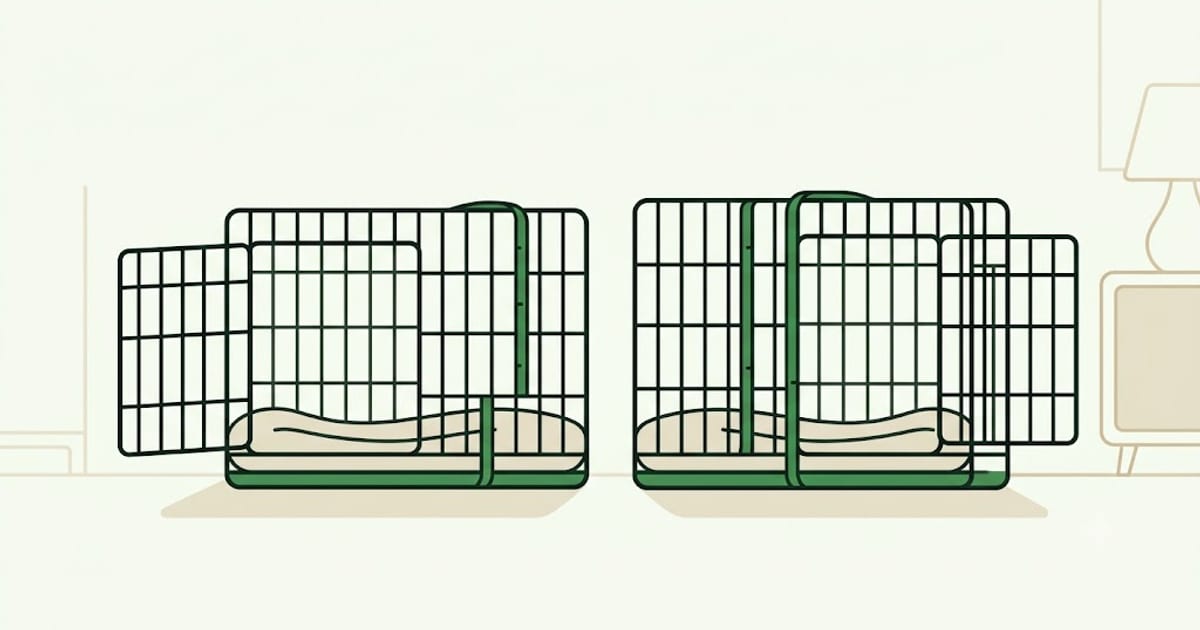
Wire crates fold flat, so two crates take one crate's storage. Side by side against a wall, two 30-inch crates take about the space of one 48.
Each dog gets its own retreat, feeding can happen in-crate, one can be crated while the other is not, and separating them for illness or recovery does not require buying anything.
Where separate crates are not optional
- House-training either dog.
- Any history of resource guarding or a squabble between them.
- A significant size difference — a large dog can injure a small one accidentally simply by lying down.
- Car travel. A shared crate lets two dogs become projectiles into each other in a stop.
- Air travel. Carriers generally require single occupancy for adult dogs.
- After surgery or during illness, where rest has to be genuine.
FAQ
Can two dogs share a crate?
Usually they should not. A crate exists to give a dog a space to withdraw to, and sharing removes that.
What size crate for two dogs?
Both lying stretched out side by side plus 2–4 inches, at the taller dog's height. Typically one to two sizes larger than either would need alone.
Can littermate puppies share a crate?
Not for house-training. The extra space lets them sleep at one end and toilet at the other.
Is it cheaper to buy one big crate?
Marginally, and two wire crates fold flat and store in about the same space as one large one.
When must dogs have separate crates?
House-training, any history of guarding, a large size difference, car and air travel, and recovery from illness or surgery.