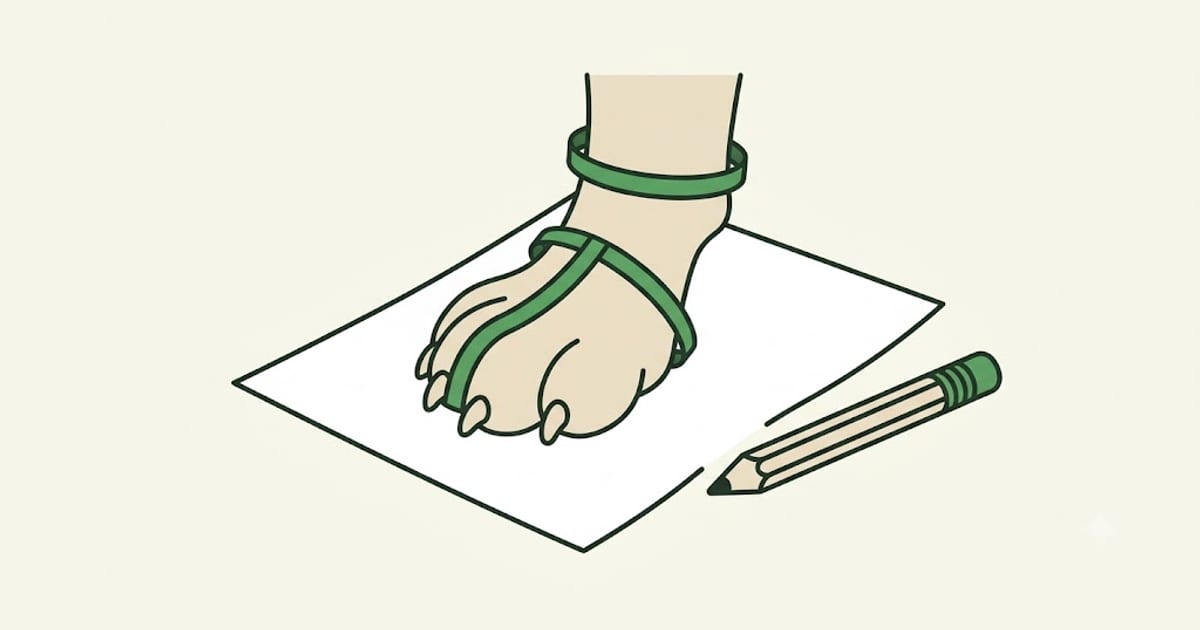
Dog boots are sized by paw width, and the measurement must be taken with the dog's weight on the paw.
A paw spreads under load — sometimes considerably. Measure a lifted foot and the number is too small, which produces a boot that either will not go on or slips off within a walk.
The method
- Stand the dog on a sheet of paper on a hard floor.
- Lift the opposite leg so full weight goes onto the paw being measured.
- Mark either side of the widest point of the paw, keeping the pencil vertical.
- Measure between the marks.
- Repeat for a back paw.
Step 5 matters. Front and back paws are usually different sizes, front generally larger. Many boot sets are sold in a single size, so measure both and decide whether you need two sizes or a set that accommodates the difference.
Fit failures, and which way they go
Too tight — the dog refuses to walk, or walks with an exaggerated high step. Refusal is usually a fit problem rather than stubbornness, and forcing it teaches the dog that boots are unpleasant, which is hard to undo.
Too loose — the boot rotates on the paw, then comes off. Lost boots on walks are almost always a sizing problem rather than a fastening one.
Too tall or too stiff — restricts the ankle and produces the same high-stepping gait as a boot that is too tight.
If a boot fits and the dog still objects, the usual cause is that boots feel strange rather than that they hurt. Short indoor sessions with rewards, before the boots are actually needed outdoors, get most dogs there.
When boots are worth it
De-icing salt. The strongest reason. Salt irritates and cracks pads, and dogs then lick it off their feet. Boots avoid both.
Hot pavement. Asphalt runs far hotter than air temperature in summer. The back of your hand held to the surface for a few seconds settles the question quickly.
Rough or sharp terrain. Scree, ice crust, sharp gravel.
Snow packing between the toes. Long-coated feet accumulate ice balls that are genuinely painful. Trimming the fur between the pads helps too, and costs nothing.
Injury protection while a pad heals — usually the first boots a dog ever wears.
Most dogs, most of the time, need none of this. Pads are tougher than they look.
Boots that stay on
Fit does most of the work, but two features help:
- Two fastening points rather than one — typically a strap at the ankle and another above it.
- A flexible sole, so the dog can feel the ground and walk naturally.
Check the fastening after the first few minutes of a walk. Straps settle as the dog moves, and the tension you set standing still is not the tension after two hundred metres.
Coat sizing, which uses a completely different measurement, is in dog coat sizing.
FAQ
How do I measure my dog's paws for boots?
Stand the dog on paper, lift the opposite leg so the paw takes full weight, mark either side of the widest point and measure between the marks.
Are front and back paws the same size?
Usually not — front paws are generally larger. Measure both.
Why does my dog refuse to walk in boots?
Most often the boots are too tight, too tall or too stiff. Check the fit before assuming it is behavioural.
Why do my dog's boots keep falling off?
Almost always a sizing problem. A boot that rotates on the paw is too large, and no fastening compensates for that.
Do dogs actually need boots?
Mainly for de-icing salt, hot pavement, rough terrain and injury protection. Most dogs do not need them for ordinary walks.