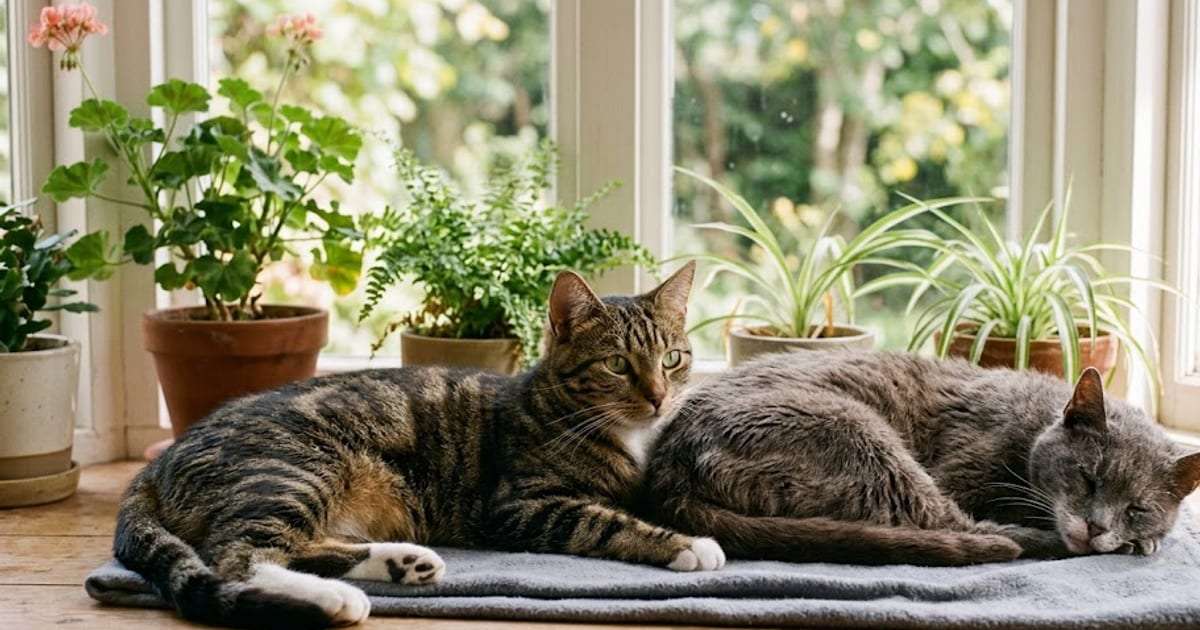
A cat's first year is equal to about 15 human years, and by its second birthday a cat is roughly 24. After that, each year of a cat's life adds about 4 human years. So a 6-year-old cat is around 40, a 10-year-old around 56, and a 14-year-old around 72.
This is the conversion used by International Cat Care and by feline veterinary guidance. It replaces the old "multiply by seven" rule, which undercounts the young years and overcounts the old ones.
Cat age chart
| Cat's age | Human equivalent | Life stage |
|---|---|---|
| 1 month | 1 year | Kitten |
| 3 months | 4 years | Kitten |
| 6 months | 10 years | Kitten |
| 1 year | 15 years | Young adult begins |
| 2 years | 24 years | Young adult |
| 3 years | 28 years | Young adult |
| 4 years | 32 years | Young adult |
| 5 years | 36 years | Young adult |
| 6 years | 40 years | Young adult |
| 7 years | 44 years | Mature adult |
| 8 years | 48 years | Mature adult |
| 9 years | 52 years | Mature adult |
| 10 years | 56 years | Mature adult |
| 11 years | 60 years | Senior |
| 12 years | 64 years | Senior |
| 13 years | 68 years | Senior |
| 14 years | 72 years | Senior |
| 15 years | 76 years | Senior |
| 16 years | 80 years | Senior |
| 17 years | 84 years | Senior |
| 18 years | 88 years | Senior |
| 19 years | 92 years | Senior |
| 20 years | 96 years | Senior |
| 21 years | 100 years | Senior |
| 25 years | 116 years | Senior |
Human equivalents follow the International Cat Care chart. Life stages follow the 2021 AAHA/AAFP Feline Life Stage Guidelines, explained below.
For a single age, the cat age calculator gives the human equivalent and life stage, with separate pages such as a 6-year-old cat in human years and a 14-year-old cat in human years.
Why the first two years count so much
Cats grow up fast. A kitten is weaned and eating solid food by about two months, can have its first litter as early as four to six months, and reaches its adult size by about a year. In human terms, a 6-month-old cat is somewhere around 10 years old, and a 1-year-old cat is in its mid-teens.
The second year brings the cat to full physical and social maturity, roughly the equivalent of a person in their mid-twenties. After that, cats age at a steadier pace, and the 4-to-1 ratio holds reasonably well for the rest of their lives.
The old "seven cat years to one human year" rule has no basis. It makes a 1-year-old cat 7, when it is already fully grown and able to reproduce, and it makes a 15-year-old cat 105, when many 15-year-old cats are active and healthy.
The life stages vets use
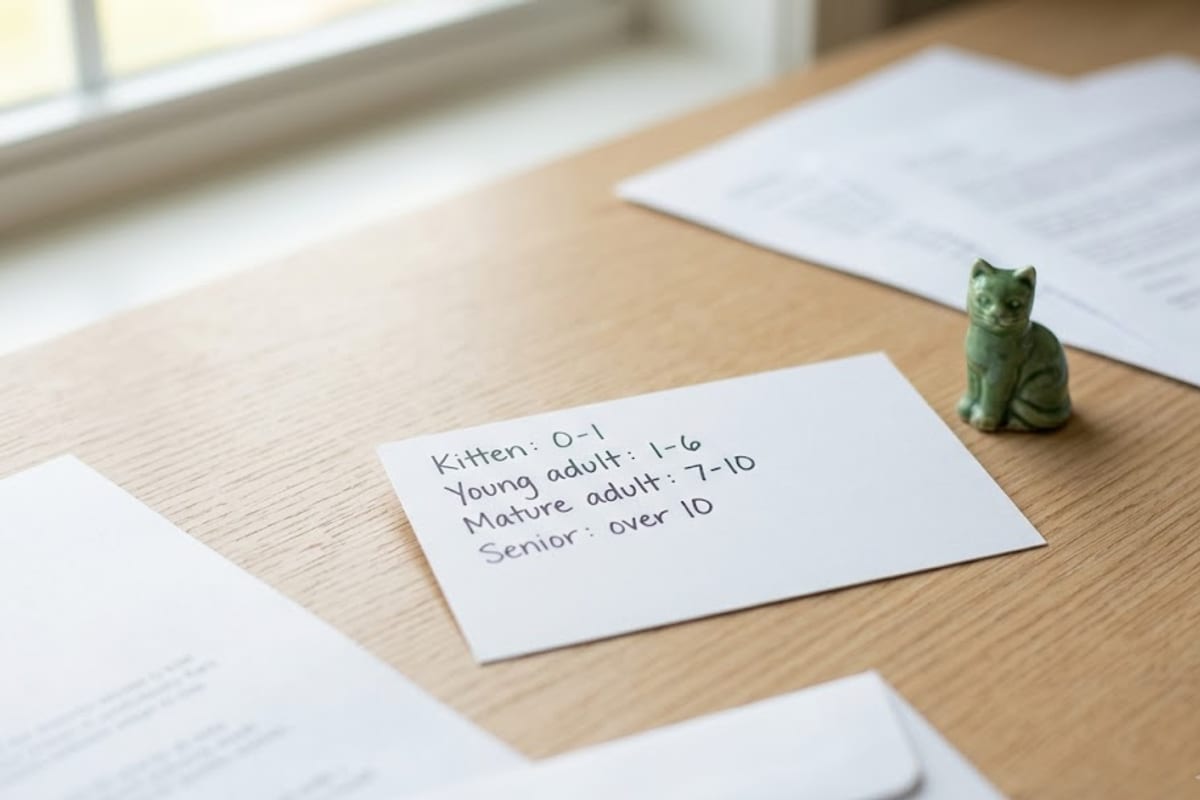
The 2021 AAHA/AAFP Feline Life Stage Guidelines, written by the American Animal Hospital Association and the American Association of Feline Practitioners, group a cat's life into four age-based stages:
- Kitten: birth to 1 year
- Young adult: 1 to 6 years
- Mature adult: 7 to 10 years
- Senior: over 10 years
A fifth stage, end of life, can happen at any age. International Cat Care uses slightly finer stages, including "super senior" for cats of 15 and over.
The stages matter because they set the pattern of veterinary care. The guidelines recommend at least yearly checkups for all adult cats and more frequent visits for seniors, often every six months, because problems like kidney disease, hyperthyroidism, dental disease and arthritis become more common with age and are easier to manage when found early.
Is 14 old for a cat?
Yes. A 14-year-old cat is a senior, roughly equal to a 72-year-old person. It is not unusually old, though. Many indoor cats live into their late teens, and cats of 20 or more are not rare.
What 14 usually means in practice:
- Joints. Most older cats have some arthritis. It rarely shows as limping. More often a cat stops jumping onto high places, hesitates on stairs, or stops using a litter box with high sides.
- Weight. Older cats often lose weight gradually, sometimes because of dental pain, kidney disease or an overactive thyroid.
- Senses and behavior. Some older cats become more vocal at night, sleep more, or seem confused at times.
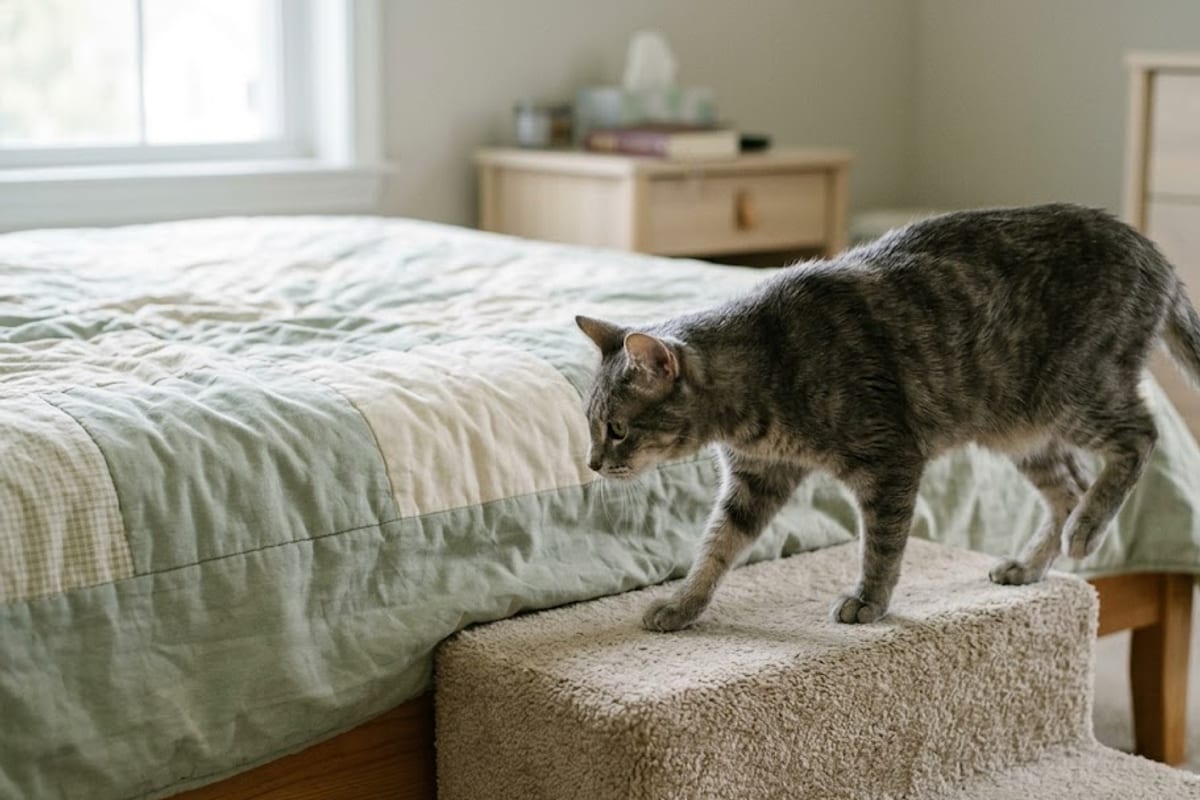
Small changes at home help an older cat a lot: a step up to a favorite bed or sofa, a litter box with a low entry, food and water where the cat does not have to jump, and a warm resting place.
Converting the other way: human age to cat age
Some people search this in reverse, for example "20 human years in cat years". Using the same scale:
| Human age | Cat age equivalent |
|---|---|
| 15 | 1 year |
| 20 | about 1½ years |
| 24 | 2 years |
| 30 | about 3½ years |
| 40 | 6 years |
| 50 | about 8½ years |
| 60 | 11 years |
| 70 | about 13½ years |
| 80 | 16 years |
From age 24 onward, subtract 24 from the human age, divide by 4, and add 2.
Weighing an older cat
Weight loss is one of the earliest signs of illness in older cats, and it is easy to miss under fur. A cat that drops from 10 pounds to 9 has lost 10% of its body weight, which is significant.
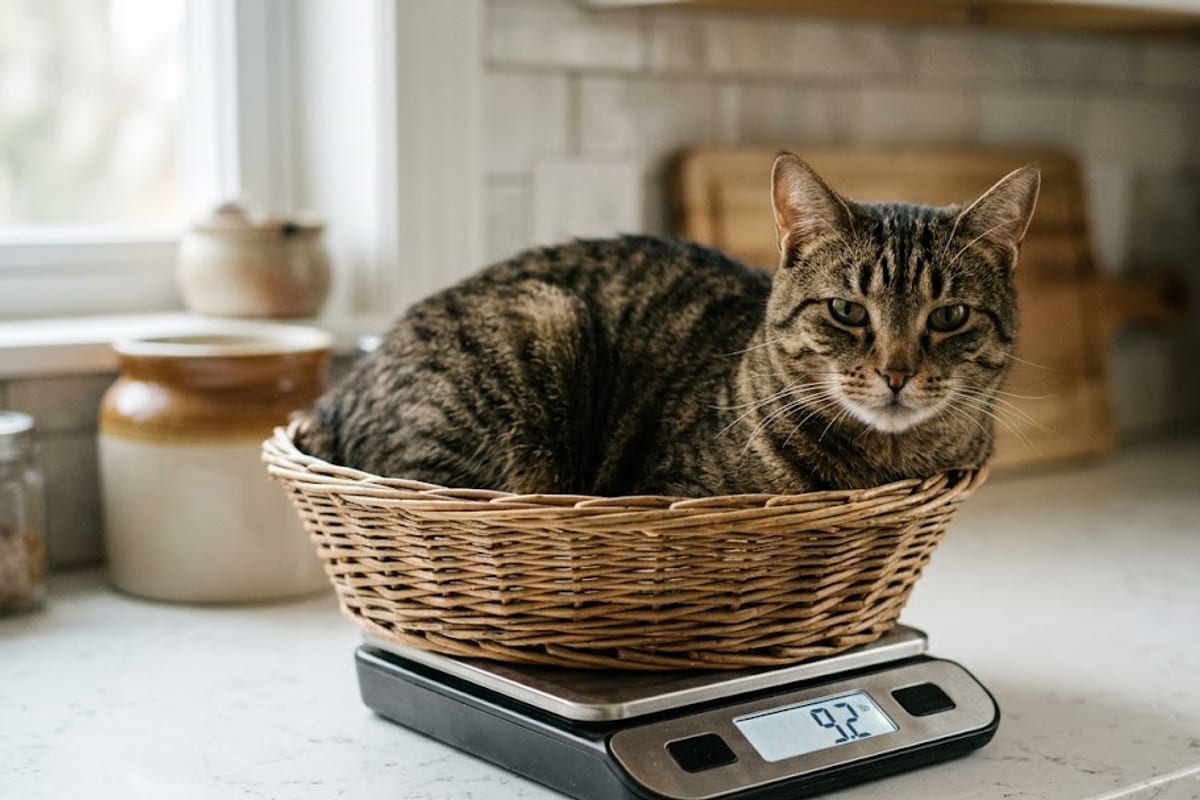
Weigh a senior cat monthly. A kitchen scale with a basket or box on it works well: weigh the empty basket, then the basket with the cat, and subtract. Keep a record. A steady drop over two or three months is a reason for a vet visit, even if the cat seems well.
Does breed or lifestyle change the chart?
The chart is a general guide for all cats. Individual cats age differently. Indoor cats generally live longer than cats that roam outdoors, because they are exposed to fewer injuries, infections and traffic. Some breeds have particular health problems that can shorten life, and mixed-breed cats often live as long as or longer than purebred cats. None of this changes the conversion, which describes stages of development and aging rather than a lifespan prediction.
Estimating the age of a cat you adopted
Many cats come from shelters or off the street with no birth date. A vet can usually estimate age within a range from a few signs:
- Teeth. Kittens have all their baby teeth by about 8 weeks and their adult teeth by about 6 months. After that, wear, tartar and gum changes build up over the years, though diet and dental care make this a rough guide.
- Eyes. Young cats have clear, bright eyes. Older cats may show slight cloudiness of the lens or a lacy look to the iris.
- Coat and muscle. Young adults tend to have a sleek coat and firm muscle. Seniors often lose muscle over the spine and hips and may groom less, leaving the coat looking dull or matted.
- Behavior and mobility. Stiffness after rest, reluctance to jump, and more sleep suggest an older cat.
A vet estimate is a range, not a date. Once you have it, you can place the cat on the chart above and plan its care for that life stage.
Kittens: the fastest part of the chart
The first year moves so quickly that a few weeks make a real difference. A 3-month-old kitten is roughly a 4-year-old child in development, and by 6 months it is closer to a 10-year-old. Kittens need several small meals a day of kitten food, their vaccination course, and, for most pet cats, spaying or neutering around 4 to 6 months, before they can reproduce.
How long do cats live?
Most pet cats live into their teens, and many indoor cats reach 15 to 20. That puts a typical indoor cat's life, in human terms, somewhere between the mid-70s and the mid-90s. A cat that reaches 20 is about 96 in human years, which is old but not exceptional, and a small number of cats live into their mid-twenties.
Frequently asked questions
How old is a 1-year-old cat in human years? About 15.
What is 6 in cat years? A 6-year-old cat is about 40 in human years, at the end of the young adult stage.
At what age is a cat considered a senior? Over 10 years, under the AAHA/AAFP guidelines.
How old is a 20-year-old cat in human years? About 96.
Is the dog age conversion the same? No. Dogs age at different rates depending on size, so there is no single chart. The dog age in human years pages convert by breed.